The exhibition ended this past Saturday and I'm happy with how things turned out. Made some sales and there are prospects for more, plus more people got to see the new work and that's always a good thing.
Also, on Saturday morning, I gave a talk to some children that came to the gallery as part of a church program for underprviledged youth based in Chester County, just outside of Philly. There were about 8 kids, aged 5-12, none of which had been in an art gallery before, and four adults. One of Bridgette's clients set up the trip and led the teaching aspect of of the discussion. I introduced myself and talked a little bit about myself and what I do as a painter. It was kind of hard at first, because I had to find different language to use than I usually do when describing my work. In other words, I had to make it simpler than usual as I'm not used to talking with younger students about my work.
Anyway, the students looked around the gallery, checked out the paintings and started linking images in the works to what they've seen in the world around them. They were really enthusiastic and asked a lot of questions. Later, they had the chance to do some drawing and coloring of their own and at the end, talked about what they did.
......
Going into this experience, I was kind of nervous since I'd not really interacted with younger students in the past. Once things got going and there was someone there handling the teaching end of the discussion (using some of the paintings as examples and asking the kids about different aspects of the images, I felt better. My reticence had more to do with it being a new experience more than anything. I've spoken to high school and college seniors about art in the past, but not younger kids.
They were attentive and appreciated being there and seemed to have a good time. I was happy to be able to give some time for this. It was really important for me, not only as an artist, but also as an African-American male who has worked to follow his dreams and has been actually living it. It felt good being an example to those kids of what's possible for them and that there are ways for them to express themselves beyond what they may already be used to.
I remember having a similar experience when I was in high school, 11th grade, I think. Our regular art teacher was out and we had a substitute for this one day. The sub was an African-American and an artist. The first thing I remember being struck by was his afro. This was the mid-80's and I hadn't seen anyone really wear one in a while. Anyway, he comes into class, big afro and bright yellow shirt, black slacks and tie. He's dragging in huge rolls of yellow paper and a briefcase. He puts his stuff down looks around, introduces himself (I have no clue what his name was), and takes roll.
With roll-call over, he begins to unfurl the rolls of paper and tack them up along the back wall. They were charcoal drawings of nudes. The drawings were of black people in various poses. Some were portraits and others were more like figure studies. I think everyone in the class was momentarily shocked, particularily the white kids. We knew about art nudes and such, but none of us had seen anything like this in the school before. I was impressed with the drawings and even more impressed when the substitute began talking about his work. At that point, I hadn't met any black artists before and there was something really powerful in how he spoke about his art and himself. That's stuck with me for a long time, obviously.
I can only hope that my time with the students at the gallery will be remembered in some form or another.
Monday, September 26, 2005


Monday, September 19, 2005
the other side of art
Last Wednesday, I talked to a group of senior art students at UArts. That Monday, my friend and fellow artist and gallery owner, Shelly Spector, asked me if I'd be interested in speaking to a group of students she was teaching. Her class is all about the side of art-making most of us don't enjoy that much: the business end of things. I jumped at the opportunity because there are too many art students who graduate from art schools without much knowledge about the administrative side of being artists. Sure, they might be talented, but can they write an effective artist statement and know how to present their resumés?
Shelly asked me to talk about how my career has grown and how I've come to where I am now. This particular session focused on building an artist resumé. I talked about how I got started showing (cafés and bookstores) and how one thing led to another through my entering various juried exhibitions and other competitions, including the Fleisher Challenge and having my work published in New American Paintings.
When Shelly asked me to talk to her students, I was flattered and nervous at the same time. I've spoken to students in my studio, but this was the first time I was going to speak in a classroom. I was out of my home base and wondered if I could still do what I needed to. The experience was good. I was nervous and it helped that I was sitting in a chair at the front of the class next to Shelly. I felt like I had something to ground me a little. It was a bit intimidating sitting there with all of these expectant eyes on me, waiting for whatever 'wisdom' I had to impart.
Even though I've come to a point in my career where I can speak somewhat authoritively about what I've done and been through as an artist, there was still that sense of 'what the hell am I doing?' while speaking? I tried to make sure I made as much sense as possible, and not stray too far from the topic at hand. The thing that helped me the most was that over the years, I've gotten better at talking about my work as an artist. At one point in the class, Shelly asked me if this was ten years ago, would I have been able to talk about my work in the same way as I can now. The answer was obviously 'no'. Sure, I might have been able to speak about what I was doing, but not in the same way I can now. That has come about only through a lot of hard work on my part and staying engaged with my life as a creative person.
Shelly asked me to talk about how my career has grown and how I've come to where I am now. This particular session focused on building an artist resumé. I talked about how I got started showing (cafés and bookstores) and how one thing led to another through my entering various juried exhibitions and other competitions, including the Fleisher Challenge and having my work published in New American Paintings.
When Shelly asked me to talk to her students, I was flattered and nervous at the same time. I've spoken to students in my studio, but this was the first time I was going to speak in a classroom. I was out of my home base and wondered if I could still do what I needed to. The experience was good. I was nervous and it helped that I was sitting in a chair at the front of the class next to Shelly. I felt like I had something to ground me a little. It was a bit intimidating sitting there with all of these expectant eyes on me, waiting for whatever 'wisdom' I had to impart.
Even though I've come to a point in my career where I can speak somewhat authoritively about what I've done and been through as an artist, there was still that sense of 'what the hell am I doing?' while speaking? I tried to make sure I made as much sense as possible, and not stray too far from the topic at hand. The thing that helped me the most was that over the years, I've gotten better at talking about my work as an artist. At one point in the class, Shelly asked me if this was ten years ago, would I have been able to talk about my work in the same way as I can now. The answer was obviously 'no'. Sure, I might have been able to speak about what I was doing, but not in the same way I can now. That has come about only through a lot of hard work on my part and staying engaged with my life as a creative person.
Thursday, September 15, 2005
Exhibition pics
A few installation shots of my exhibition at the Bridgette Mayer Gallery can be seen here
 | logical progression1 From the gallery door |
Friday, September 09, 2005
good news to wake up to
I received an email from Vince this morning congratulating me for having a good review in the Philadelphia Inquirer. Of course, that meant throwing on the first shirt and pair of shorts I could lay my hands on and running to the corner to grab a paper.
Here's the link:
Philadelphia Inquirer review
Full text:
Abstract urbanism
While remaining primarily abstract, Tim McFarlane's
new paintings at the Bridgette Mayer Gallery have
moved away from the scheme of stripes and color blocks
that characterized his previous exhibition.
The new paintings, which are more gestural and look
more improvisational, create a distinctive mood of
urban complexity. Their architecture, based on
irregular, freehand grids that look like ladders or
street plans, is more fluid and spirited.
McFarlane prefers high-voltage color, so much so that
even his whites are dazzling. Strong colors, combined
with layering of the "ladder" shapes, produces a
visual metaphor for high-density urban synergy.
This effect comes across powerfully in paintings such
as Burst, dominated by intense red, yellow and orange,
and Folding in on History, in which a white top layer
pushes toward the viewer.
The complexity of McFarlane's paintings, all acrylics
on canvas, is further magnified by their transparency.
Although most are several layers deep, one can see
through the grids and "ladders" all the way to the
bottom of the stacks. This produces a lively
counterpoint between airiness and structure akin to
the most imaginative jazz improvisation.
-Edward Sozanski
Philadelphia Inquirer Art Critic
Here's the link:
Philadelphia Inquirer review
Full text:
Abstract urbanism
While remaining primarily abstract, Tim McFarlane's
new paintings at the Bridgette Mayer Gallery have
moved away from the scheme of stripes and color blocks
that characterized his previous exhibition.
The new paintings, which are more gestural and look
more improvisational, create a distinctive mood of
urban complexity. Their architecture, based on
irregular, freehand grids that look like ladders or
street plans, is more fluid and spirited.
McFarlane prefers high-voltage color, so much so that
even his whites are dazzling. Strong colors, combined
with layering of the "ladder" shapes, produces a
visual metaphor for high-density urban synergy.
This effect comes across powerfully in paintings such
as Burst, dominated by intense red, yellow and orange,
and Folding in on History, in which a white top layer
pushes toward the viewer.
The complexity of McFarlane's paintings, all acrylics
on canvas, is further magnified by their transparency.
Although most are several layers deep, one can see
through the grids and "ladders" all the way to the
bottom of the stacks. This produces a lively
counterpoint between airiness and structure akin to
the most imaginative jazz improvisation.
-Edward Sozanski
Philadelphia Inquirer Art Critic
Monday, September 05, 2005
A good time
Friday's opening reception was great. I couldn't have asked for a better turnout. I arrived an hour early but by the 'official' time at 6pm, things were on a roll and didn't stop until the very last minute. People came and went but a lot hung out for a good while, despite the heat generated by so many bodies in the small space of the gallery. I was concerned beforehand about how many people might actually show up because of it being a holiday weekend, the Live Arts/Fringe festival starting and a number of other gallery openings going on at the same time as mine. Turns out I certainly didn't have to worry about attendance after all.
There was quite a bit of surprise from people who hadn't seen the new work. I received a lot of great comments about the paintings from people who know me and those that didn't, which is usually a good sign. Managed to sell one painting that night and there are hint of more sales coming. We'll see what happens. The review in the Philadelphia Weekly seemed to generate a lot of interest, also. It was interesting attempting to carry on three conversations at once.
Now that the opening is over with, I'm returning to studio mode. I have a commission to work on over the next couple of weeks and I'm gearing up for October, which is going to be a really busy month. There's the show at Gallery Siano that I'm a part of. I'm on a jury panel at the Bryn Mawr Rehab Hospital for their annual 'Art Ability' show. It's an international exhibit of artwork by artists with disabililties. Next up on the 15th and 16th, is the Philadelphia Open Studio Tour. Then, on the last week of October, I'll have work up at the Affordable Art Fair in New York. My work was chosen, along with that of nine other artists from the gallery, to be shown in the booth there.
There's nothing past the end of October coming up, but I'm hoping to have my work in shows outside of Philly next year. Besides that, I'm bursting at the seams with new ideas for paintings, so if nothing else, I'll keep myself busy during the winter.
There was quite a bit of surprise from people who hadn't seen the new work. I received a lot of great comments about the paintings from people who know me and those that didn't, which is usually a good sign. Managed to sell one painting that night and there are hint of more sales coming. We'll see what happens. The review in the Philadelphia Weekly seemed to generate a lot of interest, also. It was interesting attempting to carry on three conversations at once.
Now that the opening is over with, I'm returning to studio mode. I have a commission to work on over the next couple of weeks and I'm gearing up for October, which is going to be a really busy month. There's the show at Gallery Siano that I'm a part of. I'm on a jury panel at the Bryn Mawr Rehab Hospital for their annual 'Art Ability' show. It's an international exhibit of artwork by artists with disabililties. Next up on the 15th and 16th, is the Philadelphia Open Studio Tour. Then, on the last week of October, I'll have work up at the Affordable Art Fair in New York. My work was chosen, along with that of nine other artists from the gallery, to be shown in the booth there.
There's nothing past the end of October coming up, but I'm hoping to have my work in shows outside of Philly next year. Besides that, I'm bursting at the seams with new ideas for paintings, so if nothing else, I'll keep myself busy during the winter.
Wednesday, August 31, 2005
exhibition review
The first review of my exhibition is out and the word is very good :) It's by Roberta Fallon, who writes for the Philadelpha Weekly. The same review appears on the Weekly's website and on Fallon's and Libby Rosof's Artblog.
The full review text is below:
Tim McFarlane: Logical Progression
Ebullient is the word for Tim McFarlane's new paintings at Bridgette Mayer Gallery. Jazzy abstract compositions of bright-colored ladders thrusting this way and that, McFarlane's new square-format acrylics are a symbolic expression of urban space and community. Unlike the striped walls, exquisite sky and mathematical precision of his first solo with Mayer, here the artist has lost the precision and the muted colors. He's in dreamy fly-over mode where everything floats by and you're looking down from your perch in the clouds. Bridges, buildings, roads, playgrounds-all suggested by the layered ladder forms-stream by in rhythms that evoke the flow of a river.
Also hinted at, and this is consistent with the artist's previous works, is the ebb and flow of humanity-cities crowded with people of all shapes, sizes, colors. But the message is one of togetherness, respect, coexistence and even playful snuggling. McFarlane's ratcheted up his palette into the neighborhood where Faith Ringgold, Andy Warhol and Sol LeWitt live. These are beautiful works. The show's titled "Logical Progression," and the work is that. But it's also a bold move into riskier territory by a painter who deserves a Pew, dammit.
Fri., Sept. 2, 6-8:30pm. Free. Through Sept. 24. Bridgette Mayer Gallery, 709 Walnut St., first fl. 215.413.8893.
The full review text is below:
Tim McFarlane: Logical Progression
Ebullient is the word for Tim McFarlane's new paintings at Bridgette Mayer Gallery. Jazzy abstract compositions of bright-colored ladders thrusting this way and that, McFarlane's new square-format acrylics are a symbolic expression of urban space and community. Unlike the striped walls, exquisite sky and mathematical precision of his first solo with Mayer, here the artist has lost the precision and the muted colors. He's in dreamy fly-over mode where everything floats by and you're looking down from your perch in the clouds. Bridges, buildings, roads, playgrounds-all suggested by the layered ladder forms-stream by in rhythms that evoke the flow of a river.
Also hinted at, and this is consistent with the artist's previous works, is the ebb and flow of humanity-cities crowded with people of all shapes, sizes, colors. But the message is one of togetherness, respect, coexistence and even playful snuggling. McFarlane's ratcheted up his palette into the neighborhood where Faith Ringgold, Andy Warhol and Sol LeWitt live. These are beautiful works. The show's titled "Logical Progression," and the work is that. But it's also a bold move into riskier territory by a painter who deserves a Pew, dammit.
Fri., Sept. 2, 6-8:30pm. Free. Through Sept. 24. Bridgette Mayer Gallery, 709 Walnut St., first fl. 215.413.8893.
Monday, August 22, 2005
Done! (for now)
The paintings are hung and they look great in the space. The whole afternoon went by in a flash. It took all of two hours to make decisions about which works were going to actually be in the exhibition and which ones wouldn't and where to place the remaining pieces. Bridgette and I were surprised by how quickly the installation went. I thought we'd be there well into the evening. Happily, that wasn't the case. I guess the toughest part was choosing which paintings to hang next to each other. It was like playing 'musical paintings' or something; shuffling paintings from one place to another in attempts to come up with the best combinations.
I was happy that everything was done, but too tired to show any real excitement. That came from not getting enough sleep last night. I had some last-minute painting to do on the edges of some paintings and had this elaborate plan to get up around 5:30 this morning. I planned it that way because I was having someone meet me with a van at 10:30am to help deliver the works. I needed some time to make sure everything dried in time. Well, my alarm clock went off on time and I slept for another hour and another until I finally got up sometime close to 8am. Went up to the studio, did what I had to do, and still had time to spare. I really wished that I hadn't been so paranoid about it, but I'd rather be safe than sorry and lose a little sleep.
......
I'm experiencing a mixture of excitement, dread, and relief at the same time. I'm happy with the work and I'm glad everything went as smoothly as it did. However, now comes the time that other people will see these works for the first time in person. I've been living with them for nine months, more if you count the amount of time I had the ideas swirling around in my head before I began painting this series last November. The thing is, the show is up and I can breathe a sigh of relief and take it easy for a couple of days, at least. There's still more to do, but that's mainly in the way of continuing to get the word out about the show. I grabbed a huge pile of postcards to hand out before leaving the gallery. I'll probably run through them in no time. The main mailing is done, so I can go crazy with handing them out.
......
This show is happening at a significant time for me because I feel like there's real potential for continued exploration with the new images and ideas. The last show was the culmination of four years of working within a particular set of ideas. This time, instead of wondering what to do next, I have a whole new set of artistic challenges ahead of me that I want to explore right away. I'm not taking a break from painting after the opening reception like I did last year. There are simply too many ideas swirling around in my head right now to let slip by or rot away.
I was happy that everything was done, but too tired to show any real excitement. That came from not getting enough sleep last night. I had some last-minute painting to do on the edges of some paintings and had this elaborate plan to get up around 5:30 this morning. I planned it that way because I was having someone meet me with a van at 10:30am to help deliver the works. I needed some time to make sure everything dried in time. Well, my alarm clock went off on time and I slept for another hour and another until I finally got up sometime close to 8am. Went up to the studio, did what I had to do, and still had time to spare. I really wished that I hadn't been so paranoid about it, but I'd rather be safe than sorry and lose a little sleep.
......
I'm experiencing a mixture of excitement, dread, and relief at the same time. I'm happy with the work and I'm glad everything went as smoothly as it did. However, now comes the time that other people will see these works for the first time in person. I've been living with them for nine months, more if you count the amount of time I had the ideas swirling around in my head before I began painting this series last November. The thing is, the show is up and I can breathe a sigh of relief and take it easy for a couple of days, at least. There's still more to do, but that's mainly in the way of continuing to get the word out about the show. I grabbed a huge pile of postcards to hand out before leaving the gallery. I'll probably run through them in no time. The main mailing is done, so I can go crazy with handing them out.
......
This show is happening at a significant time for me because I feel like there's real potential for continued exploration with the new images and ideas. The last show was the culmination of four years of working within a particular set of ideas. This time, instead of wondering what to do next, I have a whole new set of artistic challenges ahead of me that I want to explore right away. I'm not taking a break from painting after the opening reception like I did last year. There are simply too many ideas swirling around in my head right now to let slip by or rot away.
Friday, August 19, 2005
closer
I'm in the final stages of exhibition prep-work. The only thing I had to do today was to attach hardware to the back of several canvases for hanging and make a list of the works I'm delivering to the gallery on Monday morning. There are 21 paintings and 6 works on paper that will be considered for the show.
The space at the gallery isn't big enough for all 21 paintings to hang at once, so Bridgette and I will be doing some 'pruning'. I have more in the way of larger works this time and I'm hoping to get most of them up. The only thing I can do now is wait and see what happens on Monday.
......
In addition to adding the hardware and making the list, I had to title a couple of the latest paintings I'd finished. I sat around for a good 45 minutes before coming up with a title for one of them. I don't like leaving works untitled because after a while, I don't have a way of recalling which ones are which. Giving them a title mainly acts as a way for me to keep track of them. Sometimes, the images beg for a written/verbal identity and I can make up a title easily. Others are much harder. When I'm painting, I'm more interested in what's going on with the images and how the work is developing. Titles are the last thing on my mind most of the time.
I have made a habit of writing down words and phrases that appeal to me in my sketchbook for later use. That's come in handy a few times because I've had too many moments of coming up with a great title only to forget it in the next second. Write it down, write it down, write it down...
The space at the gallery isn't big enough for all 21 paintings to hang at once, so Bridgette and I will be doing some 'pruning'. I have more in the way of larger works this time and I'm hoping to get most of them up. The only thing I can do now is wait and see what happens on Monday.
......
In addition to adding the hardware and making the list, I had to title a couple of the latest paintings I'd finished. I sat around for a good 45 minutes before coming up with a title for one of them. I don't like leaving works untitled because after a while, I don't have a way of recalling which ones are which. Giving them a title mainly acts as a way for me to keep track of them. Sometimes, the images beg for a written/verbal identity and I can make up a title easily. Others are much harder. When I'm painting, I'm more interested in what's going on with the images and how the work is developing. Titles are the last thing on my mind most of the time.
I have made a habit of writing down words and phrases that appeal to me in my sketchbook for later use. That's come in handy a few times because I've had too many moments of coming up with a great title only to forget it in the next second. Write it down, write it down, write it down...
Thursday, August 18, 2005
Update
The video shoot from last week went pretty well. I haven't seen it yet. I don't know if it's edited yet or not. It was hot as hell in the studio. Unfortunately, we had to turn off the fans so the camera mic wouldn't pick up the noise from the fans.
I was debating about what to wear, but wound up remaining in my tank-top and shorts that I use for painting in. I saw a video still (below) of the shoot and wasn't sure about my choice, but, whatever. I'm not really that worried about it. I mean, it is what I wear when I'm working and this is a video of me in the studio talking about my work, so why not look how I normally do?

.....
I've begun giving out some of the show brochures and the response to the images have been really positive. The postcards have been arriving at their destinations, also a good thing. The items that remain to be taken care of are:
1. Adding the wire and hanging hardware to the paintings
2. Making up titles for some recent paintings
3. Getting the paintings to the gallery (Monday), an issue that is taken care of, courtesy of Deb and Allen. Thanks guys!!!
I was debating about what to wear, but wound up remaining in my tank-top and shorts that I use for painting in. I saw a video still (below) of the shoot and wasn't sure about my choice, but, whatever. I'm not really that worried about it. I mean, it is what I wear when I'm working and this is a video of me in the studio talking about my work, so why not look how I normally do?

.....
I've begun giving out some of the show brochures and the response to the images have been really positive. The postcards have been arriving at their destinations, also a good thing. The items that remain to be taken care of are:
1. Adding the wire and hanging hardware to the paintings
2. Making up titles for some recent paintings
3. Getting the paintings to the gallery (Monday), an issue that is taken care of, courtesy of Deb and Allen. Thanks guys!!!
Wednesday, August 17, 2005
Green
Green has been on my mind for a while now. I don't really know why, but it has. It's one of the colors I gravitated towards a lot when working on my latest paintings. Even though I'm a city person, born and bred, I love the outdoors. I've been so busy this summer that I haven't spent much time out in nature. Nevertheless, the green thing has been nagging at me for a while, just sitting at the back of my mind and poking me every once in a while. I came across this photo by German artist, Thomas Demand in the latest issue of Adbusters magazine.
Thomas Demand's work process is exacting and encompasses sculpture and photography. He builds life-sized enviornments almost entirely out of paper and then photographs them. The resulting photos are themselves printed on a life-size acale. The scenes, like the one I linked to, appear life-like at first glance, but closer inspection will reveal many small, but important details that may be missing or that clue you into what he's actually done. For example, with The Clearing, Demand made every leaf out of paper. He's done other interior/exterior scenes which also play around with perceptions of reality and the manufactured image, which sits well within the contemporary art world's obsession with irony, but that's a whole other thing I don't want to get into here.
Demand's photograph, in addition to the journal change combined to set off the spark for what I think will be a new series of paintings. All I know right now is that the color green and as many variants as I can come up with combined with other colors is going to play a prominent role. Some will be more monochromatic and others less so, I think. I was also was working on a crossword puzzle which had as a clue, "like many rain forests". The answer was 'lush'.
This is just the bare surface of an idea. I'll see where it goes from here. I'll have to file it with 'proposed projects' right behind the ten other ideas I have brewing in my head. There's just not enough time...
......
Received some good news from Bridgette today. The postcards for my exhibition have begun to arrive in the mail and so far, the feedback has been good. One of her clients was interested in the painting on the cover of the postcard, Logical Progression (also the title of the exhibition), below. However, he doesn't have space for it (it measures 36"x36") and wants to commission a smaller version of it. Bridgette told him before even calling me that the resulting painting won't look like this painting. It was done fairly early in the series and even though only three months seperate that the newer paintings from this one, they've evolved past the stage I left this one in.
Anyway, Bridgette and I talked about it and I thought it would be an interesting challenge to undertake. I had it in my mind to do more like Logical Progression, but wound up moving into new territory before I could pursue the idea any further. The main idea was to have mulitple grid structures dropping down from the upper edge of the canvas, flowing over each other and taking over the canvas surface. This was actually the second version of this idea. The later paintings have a less rigid line quality to them. There's still the grid, but it's morphed into something more organic looking in more recent paintings.
He only wants one, but I'm thinking I'll do two, maybe three, just to see where I can take the idea. The client is puttng up a non-refundable chunk of the cost up front and I should have it by the end of this week. A good thing, since I'll be able to use that exclusively for materials and not have to use my own money for it.

Tim McFarlane
Logical Progression
2005
acrylic on canvas
36"x36"
Thomas Demand's work process is exacting and encompasses sculpture and photography. He builds life-sized enviornments almost entirely out of paper and then photographs them. The resulting photos are themselves printed on a life-size acale. The scenes, like the one I linked to, appear life-like at first glance, but closer inspection will reveal many small, but important details that may be missing or that clue you into what he's actually done. For example, with The Clearing, Demand made every leaf out of paper. He's done other interior/exterior scenes which also play around with perceptions of reality and the manufactured image, which sits well within the contemporary art world's obsession with irony, but that's a whole other thing I don't want to get into here.
Demand's photograph, in addition to the journal change combined to set off the spark for what I think will be a new series of paintings. All I know right now is that the color green and as many variants as I can come up with combined with other colors is going to play a prominent role. Some will be more monochromatic and others less so, I think. I was also was working on a crossword puzzle which had as a clue, "like many rain forests". The answer was 'lush'.
This is just the bare surface of an idea. I'll see where it goes from here. I'll have to file it with 'proposed projects' right behind the ten other ideas I have brewing in my head. There's just not enough time...
......
Received some good news from Bridgette today. The postcards for my exhibition have begun to arrive in the mail and so far, the feedback has been good. One of her clients was interested in the painting on the cover of the postcard, Logical Progression (also the title of the exhibition), below. However, he doesn't have space for it (it measures 36"x36") and wants to commission a smaller version of it. Bridgette told him before even calling me that the resulting painting won't look like this painting. It was done fairly early in the series and even though only three months seperate that the newer paintings from this one, they've evolved past the stage I left this one in.
Anyway, Bridgette and I talked about it and I thought it would be an interesting challenge to undertake. I had it in my mind to do more like Logical Progression, but wound up moving into new territory before I could pursue the idea any further. The main idea was to have mulitple grid structures dropping down from the upper edge of the canvas, flowing over each other and taking over the canvas surface. This was actually the second version of this idea. The later paintings have a less rigid line quality to them. There's still the grid, but it's morphed into something more organic looking in more recent paintings.
He only wants one, but I'm thinking I'll do two, maybe three, just to see where I can take the idea. The client is puttng up a non-refundable chunk of the cost up front and I should have it by the end of this week. A good thing, since I'll be able to use that exclusively for materials and not have to use my own money for it.
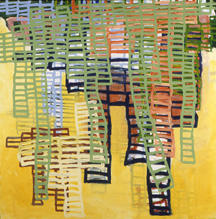
Tim McFarlane
Logical Progression
2005
acrylic on canvas
36"x36"
Thursday, August 11, 2005
now you see me...
Alright, so tomorrow, or rather, later this morning, I'm doing a video shoot at my studio. The resulting dvd will be played at the opening reception for my exhibition(scroll down) in the fall. Until yesterday, I had nothing written down about what I wanted to say. I've been thinking about the work for months now, as I've been creating it. I've also been documenting my thoughts here as well. By now, I have a pretty good idea of what I want to talk about. My gallerist, Bridgette, felt that it would be good to write down some thoughts and questions just so I have an idea of what I wanted to say in a coherent manner. I agreed to do it, but couldn't really focus on writing it until yesterday and it was a few weeks ago that she brought it up.
In that time, however, I was able to run different ideas through my head, study the paintings I've done, and in less than an hour, came up with four main talking points that could have been expanded into more. I do want to keep it somewhat brief and digestible; there's nothing worse than an artist rambling on and on about this idea and that when on film. I just want to make sure my ideas come across in a clear, meaningful way.
Visual art has many layers and filters, but the main one I'm engaged in for this project is artwork-viewer-artist. I'm going with this order because most viewers of art interact with the art object and, in most cases, never meet the artist (I'm confining this to living artists for the sake of simplicity). The video will give the public a chance to see a layer in the art process that few have the opportunity to witness, that of the me discussing my work in the place the paintings were made: the studio. I think most people don't really know or understand what goes on before they see the work in a public or private space. As tenuous a connection a video of me talking about the work is, it can go a long way towards educating the public and helping them gain a better understanding of the creative urge and process.
Now, if I can figure out what to wear. Well, I know I'll have to wear something black...so people know that I'm a serious artist ;P
In that time, however, I was able to run different ideas through my head, study the paintings I've done, and in less than an hour, came up with four main talking points that could have been expanded into more. I do want to keep it somewhat brief and digestible; there's nothing worse than an artist rambling on and on about this idea and that when on film. I just want to make sure my ideas come across in a clear, meaningful way.
Visual art has many layers and filters, but the main one I'm engaged in for this project is artwork-viewer-artist. I'm going with this order because most viewers of art interact with the art object and, in most cases, never meet the artist (I'm confining this to living artists for the sake of simplicity). The video will give the public a chance to see a layer in the art process that few have the opportunity to witness, that of the me discussing my work in the place the paintings were made: the studio. I think most people don't really know or understand what goes on before they see the work in a public or private space. As tenuous a connection a video of me talking about the work is, it can go a long way towards educating the public and helping them gain a better understanding of the creative urge and process.
Now, if I can figure out what to wear. Well, I know I'll have to wear something black...so people know that I'm a serious artist ;P
Thursday, August 04, 2005
searching
"I have forced myself to contradict myself in order to avoid conforming
to my own taste." - Marcel Duchamp
I love this quote. It epitomizes a large aspect of my creative practice. That is, I'm constantly challenging myself to push ahead with my work. The reason I do so is to keep from feeling like I'm repeating myself and allowing my painting to become too 'easy'. The moment I find myself not being challenged somehow by an idea or series I'm working on, I'm off trying to find some way to throw a monkey wrench in the works. Not to mess things up just for the sake of it, but to see what else I can do to keep my art relevant and meaningful to me.
One of the things I like to do while painting is to turn it over so that the image that was right-side up is now reversed. That, or I'll rotate it and look at it from all four sides to see if there is a more interesting composition emerging. I'll do this several times, even after I've 'finished' the piece, just to make sure it feels right in it's final orientation.
to my own taste." - Marcel Duchamp
I love this quote. It epitomizes a large aspect of my creative practice. That is, I'm constantly challenging myself to push ahead with my work. The reason I do so is to keep from feeling like I'm repeating myself and allowing my painting to become too 'easy'. The moment I find myself not being challenged somehow by an idea or series I'm working on, I'm off trying to find some way to throw a monkey wrench in the works. Not to mess things up just for the sake of it, but to see what else I can do to keep my art relevant and meaningful to me.
One of the things I like to do while painting is to turn it over so that the image that was right-side up is now reversed. That, or I'll rotate it and look at it from all four sides to see if there is a more interesting composition emerging. I'll do this several times, even after I've 'finished' the piece, just to make sure it feels right in it's final orientation.
Saturday, July 30, 2005
Transitional connections
Checked out You, Me, and Everyone We Know last night. It's a small, quiet film centered around relationships and transition. It takes place during a time of major and minor upheavals in the lives of most of the characters.The film seems to exist neither here nor there but somewhere in between. By the end, there are revelations but not much in the way of resolution; the future is an open book for these characters. It's very 'artsy', which is no surprise since it's written and directied by Miranda July, a performance artist and filmmaker. Her take on what some artists go through with their work and getting it recognized is fairly dead on. This is the first non mainstream summer movie I've seen this year and I'm glad I took the time to take a break from the usual brain candy.
......
I felt a connection with the transitional aspect of You, Me,... as it relates to one of the foundations of my artwork. I began using abstract imagery years because I wanted to explore a similar ambuguity. I needed to use imagery that was not recognizably 'this' or 'that' but existed someplace in between. It was the logical thing for me to do in adopting a visual vocabulary that went beyond the established symbolic meanings associated with representational images or objects. Abstraction or Non-Objectivity freed me from the constraints of meanings readily placed on recognizable subjects; I was now able to construct images that could possibly have infinite levels of meaning for viewers.
......
What does it mean to have an image exist 'in between'? In between what? In between where?
At the end of a long work day, my mind rapidly begins to 'empty out'; it starts to drift and wander here and there. I'm well aware of my surroundings, but I'm also turning inward a little. As my mind quiets down from the overstimulation and demands of work, I begin to hear my own footsteps as if for the first time. I'll slow down and think about things such as all of the minute and grand things that are taking place as I take each step. Not only that, but what's happening as my other foot is making the move forward-the heel of my sneaker rising, my foot arching, the heel touching ground again. How much do you think has happened in those couple of moments? All over the world, trillions upon trillions of events have taken place and we are only consciously aware of a tiny fraction of them.
Any event I might think of as 'in between' really isn't really that at all. I think it's nearly impossible to define what's 'in between'. So why try to capture it at all if it really can't (as far as I know) be captured at all. There's the quandry-how do you capture something you aren't even sure exists? Especially with a static medium like paint on canvas. Can it even be defined as an image, sound, or combnination thereof? Who knows? Maybe...However, that leaves me with one thing: the challenge of the chase. I know I'll never really capture or own 'in between' in any manner whatsoever, but I can use my limited understanding of it, along with what I know of my interactions with my surroundings to construct a visual narrative. Thinking back over the years of work I've done, I've always returned again and again to various incarnations of my fascination with the spaces between things, places and events.
......
Spent some time painting today. I can't say I had the best concentration. I had to take care of some pre-show stuff which included dropping off drawings at Seven Arts framing. Bridgette's going to pick them up on Saturday, Aug. 20th. We also set an installation date: Monday, August 22nd. The show opens on Wednesday, August 31st and the reception is on Friday, Sept. 3rd. I'll go in and work some more tomorrow evening.
......
I felt a connection with the transitional aspect of You, Me,... as it relates to one of the foundations of my artwork. I began using abstract imagery years because I wanted to explore a similar ambuguity. I needed to use imagery that was not recognizably 'this' or 'that' but existed someplace in between. It was the logical thing for me to do in adopting a visual vocabulary that went beyond the established symbolic meanings associated with representational images or objects. Abstraction or Non-Objectivity freed me from the constraints of meanings readily placed on recognizable subjects; I was now able to construct images that could possibly have infinite levels of meaning for viewers.
......
What does it mean to have an image exist 'in between'? In between what? In between where?
At the end of a long work day, my mind rapidly begins to 'empty out'; it starts to drift and wander here and there. I'm well aware of my surroundings, but I'm also turning inward a little. As my mind quiets down from the overstimulation and demands of work, I begin to hear my own footsteps as if for the first time. I'll slow down and think about things such as all of the minute and grand things that are taking place as I take each step. Not only that, but what's happening as my other foot is making the move forward-the heel of my sneaker rising, my foot arching, the heel touching ground again. How much do you think has happened in those couple of moments? All over the world, trillions upon trillions of events have taken place and we are only consciously aware of a tiny fraction of them.
Any event I might think of as 'in between' really isn't really that at all. I think it's nearly impossible to define what's 'in between'. So why try to capture it at all if it really can't (as far as I know) be captured at all. There's the quandry-how do you capture something you aren't even sure exists? Especially with a static medium like paint on canvas. Can it even be defined as an image, sound, or combnination thereof? Who knows? Maybe...However, that leaves me with one thing: the challenge of the chase. I know I'll never really capture or own 'in between' in any manner whatsoever, but I can use my limited understanding of it, along with what I know of my interactions with my surroundings to construct a visual narrative. Thinking back over the years of work I've done, I've always returned again and again to various incarnations of my fascination with the spaces between things, places and events.
......
Spent some time painting today. I can't say I had the best concentration. I had to take care of some pre-show stuff which included dropping off drawings at Seven Arts framing. Bridgette's going to pick them up on Saturday, Aug. 20th. We also set an installation date: Monday, August 22nd. The show opens on Wednesday, August 31st and the reception is on Friday, Sept. 3rd. I'll go in and work some more tomorrow evening.
Wednesday, July 27, 2005
On the needs of visual artists
I was catching up on my art blogs today and came across an entry on Roberta Fallon and Libby Rosof's Artblog that caught my eye. The post is from sculptor, Charles Hankin and is titled "On The Needs of Visual Artists". Just scroll down the page a bit to see it. The following is my reply:
......
I agree with a lot of what sculptor Charles Hankin wrote in his entry. Particularly the part about artists advocating on behalf of themselves and the arts:"We need to teach our friends, family and neighbors about art and why we are important creators. Respect for art will come from personal relationships not from an Arts Council or other government agency.
I couldn't agree more. It begins with how we view ourselves, what we do and how we present it to the outside world. I think a lot of visual artists tend to downplay what it is they actively do with most of their time. Most of us have day jobs to make ends meet, myself included. However, when someone asks me, "What do you do?", in reference to occupation, I always respond with "I'm a painter". Period. Inevitably, the question of how I support myself and my work comes up and I'll tell them that I have a job, but my main occupation is that of a painter. To me, this simple declaration puts me in a better position to be taken seriously. Not only that, I tend to take myself more seriously as a creative person.
I think a lot of us shy away from making distinct declarations because of a misguided idea that it's somehow not good to speak highly of what we do as creative people. Perhaps that is because the fine arts have some to be so devalued in our society that, for some, it's almost a stigma to mention they are an artist of some type. Maybe there are flashbacks to a childhood where parents and others made it known that pursuing the fine arts wasn't an 'appropriate', i.e. 'lucrative' or of a high enough status. That's nothing new, as it's been going on for centuries, but this attitude still defines how many of us approach our relation to the world outside of art.
Another important aspect is to speak about art and what we do in a way that viewers/participants can make connections with thier experiences in the world. That's key. If you can talk to someone who perhaps has no background in art history and get them to see connections with what you are doing with your work and the world around them, then half the battle is won, I think. This is particularly important when it comes to abstract painting, video, or installation work.
People do want to know who we are and what we do, but we have to be willing to give a little more, sometimes. We must seriously believe that what we are doing is vital to everyone, bring that messege to people in ways that inspire them, and most importantly, continue to challenge ourselves as artists, keep making the work and put it out in the world for others to experience.
......
I agree with a lot of what sculptor Charles Hankin wrote in his entry. Particularly the part about artists advocating on behalf of themselves and the arts:"We need to teach our friends, family and neighbors about art and why we are important creators. Respect for art will come from personal relationships not from an Arts Council or other government agency.
I couldn't agree more. It begins with how we view ourselves, what we do and how we present it to the outside world. I think a lot of visual artists tend to downplay what it is they actively do with most of their time. Most of us have day jobs to make ends meet, myself included. However, when someone asks me, "What do you do?", in reference to occupation, I always respond with "I'm a painter". Period. Inevitably, the question of how I support myself and my work comes up and I'll tell them that I have a job, but my main occupation is that of a painter. To me, this simple declaration puts me in a better position to be taken seriously. Not only that, I tend to take myself more seriously as a creative person.
I think a lot of us shy away from making distinct declarations because of a misguided idea that it's somehow not good to speak highly of what we do as creative people. Perhaps that is because the fine arts have some to be so devalued in our society that, for some, it's almost a stigma to mention they are an artist of some type. Maybe there are flashbacks to a childhood where parents and others made it known that pursuing the fine arts wasn't an 'appropriate', i.e. 'lucrative' or of a high enough status. That's nothing new, as it's been going on for centuries, but this attitude still defines how many of us approach our relation to the world outside of art.
Another important aspect is to speak about art and what we do in a way that viewers/participants can make connections with thier experiences in the world. That's key. If you can talk to someone who perhaps has no background in art history and get them to see connections with what you are doing with your work and the world around them, then half the battle is won, I think. This is particularly important when it comes to abstract painting, video, or installation work.
People do want to know who we are and what we do, but we have to be willing to give a little more, sometimes. We must seriously believe that what we are doing is vital to everyone, bring that messege to people in ways that inspire them, and most importantly, continue to challenge ourselves as artists, keep making the work and put it out in the world for others to experience.
Tuesday, July 26, 2005
getting there...
Received a pdf file with the proof of the exhibition brochure. There were a few corrections that needed to be made, but overall it looks great. I'm looking forward to seeing the final printed version.
......
Didn't get a lot of painting done last week, but I plan on making up for it this week. I have a meeting with Bridgette on Thursday to discuss which of the second batch of newer works I should have photographed. There's a bunch of paintings she hasn't seen yet.
......
This fall is going to be a busy one. First, there's the show in September. Then, on October 12th, I'm on the jurying panel for an international exhibition of disbled artists at Bryn Mawr Rehab Hospital. The show is called, 'Art Ability'. The weekend of October 15th/16th I'm doing the Philadelphia Open Studio Tours. Finally, at the end of the month, I'm going to have work included in Bridgette's booth at the 'Affordable Art Fair' in New York. I'm planning on being there for at least one of the days. There are a couple of friend's places I could stay while there, which is good.
......
Didn't get a lot of painting done last week, but I plan on making up for it this week. I have a meeting with Bridgette on Thursday to discuss which of the second batch of newer works I should have photographed. There's a bunch of paintings she hasn't seen yet.
......
This fall is going to be a busy one. First, there's the show in September. Then, on October 12th, I'm on the jurying panel for an international exhibition of disbled artists at Bryn Mawr Rehab Hospital. The show is called, 'Art Ability'. The weekend of October 15th/16th I'm doing the Philadelphia Open Studio Tours. Finally, at the end of the month, I'm going to have work included in Bridgette's booth at the 'Affordable Art Fair' in New York. I'm planning on being there for at least one of the days. There are a couple of friend's places I could stay while there, which is good.
Thursday, July 21, 2005
upside down in reverse
I walked into the studio just behind Gabrielle, who shares the front half of the floor with me. It's stifling hot. One of the first things both of us do is head over to open the window and doors to the fire escape. I turn on the industrial fan just before opening the window. I'm sweating buckets from the bike ride up there and there's a part of me that just wants to flop down on the couch for half an hour just to cool down, but I'm also hyped to get to work.
Gabby and I catch up on how our weekends went, I change into my painting shorts and shirt, put some music on and set up to paint. Waiting for me are two paintings I began last week. Both are in for some changes. I like some of what I did, but they don't quite feel done yet, so I study them for a while, trying to figure out what needs to change and what possible directions I can take them next. I like the look of some of the colors and forms together, but the parts aren't adding up to a whole yet.
Over the past few months, I've been challenging myself to push past what I was doing last year and the three years before that. Mainly, this means embracing a wider range of mark-making and color choices. All of which I'm very happy to do. However, there's the issue of getting what's inside of my head onto the canvas. I'm continuing with pictorial ideas that include various gridded forms placed in front of one another. There's ten or so paintings on the wall behind the easel that I'm constantly refering to for ideas to use in the newer paintings. I use the older paintings to jump start the newer pieces. I look a them and mentally pick them apart to see what I can use and if I can use some of the older ideas in a different way.
There's a constant dialogue between the newer paintings and the older ones. I try to not repeat myself too much and attempt to find any way I can to break apart what I did previously and re-make it in new ways. That's one of the biggest challenges I have as a painter; how many ways can I take a core idea and re-invent it from painting to painting until I feel it's potential is exhausted? The experimentation is great, but the paintings have to stand up on thier own. The ideas contained on the surfaces must be clear, even if they don't seem to be so upon the first viewing.
The paintings I worked on today are causing me to reconsider some ideas I have about a 'finished' composition. The forms I'm using now are much more open than previously and much less centered in place; lines and colors are moving all over the place. I let some areas build up with an accumulation of marks while others are flat and let the eye rest a bit before being taken up into more activity. The flow of information is continual and the possibilities seemingly endless. Through this process, I'm trying to let go of a default painting ideology I accumulated over the past few years and embrace more readily the open-ended spirit of the new paintings.
Gabby and I catch up on how our weekends went, I change into my painting shorts and shirt, put some music on and set up to paint. Waiting for me are two paintings I began last week. Both are in for some changes. I like some of what I did, but they don't quite feel done yet, so I study them for a while, trying to figure out what needs to change and what possible directions I can take them next. I like the look of some of the colors and forms together, but the parts aren't adding up to a whole yet.
Over the past few months, I've been challenging myself to push past what I was doing last year and the three years before that. Mainly, this means embracing a wider range of mark-making and color choices. All of which I'm very happy to do. However, there's the issue of getting what's inside of my head onto the canvas. I'm continuing with pictorial ideas that include various gridded forms placed in front of one another. There's ten or so paintings on the wall behind the easel that I'm constantly refering to for ideas to use in the newer paintings. I use the older paintings to jump start the newer pieces. I look a them and mentally pick them apart to see what I can use and if I can use some of the older ideas in a different way.
There's a constant dialogue between the newer paintings and the older ones. I try to not repeat myself too much and attempt to find any way I can to break apart what I did previously and re-make it in new ways. That's one of the biggest challenges I have as a painter; how many ways can I take a core idea and re-invent it from painting to painting until I feel it's potential is exhausted? The experimentation is great, but the paintings have to stand up on thier own. The ideas contained on the surfaces must be clear, even if they don't seem to be so upon the first viewing.
The paintings I worked on today are causing me to reconsider some ideas I have about a 'finished' composition. The forms I'm using now are much more open than previously and much less centered in place; lines and colors are moving all over the place. I let some areas build up with an accumulation of marks while others are flat and let the eye rest a bit before being taken up into more activity. The flow of information is continual and the possibilities seemingly endless. Through this process, I'm trying to let go of a default painting ideology I accumulated over the past few years and embrace more readily the open-ended spirit of the new paintings.
phantom brush
I've not held a paint brush in my hand for just over a week. That's way too long. It's been like that because I had to deal with the mailing list debacle towards the end of last week.
I've felt odd in the past when I hadn't been working in the studio for a while, but this time there's a palpable difference. You know what they say about people who have a limb amputated, that the amputee continues to 'feel' the limb even though it's not there. I believe it's referred to as a 'ghost limb' or something like that. Well, that's how I've been feeling since at least a couple of days ago. I usually paint with my right hand but have used my left from time to time. It's my right hand that my mind has assigned the feeling of a missing brush to. It's a distinct feeling, also. It's one of my larger brushes. I can make out the smooth wood and the slight change in thickness along the handle. It's as if I'm just about to lay down some color or make a line or two.
......
painted
looked
painted
looked
turned it upside down
looked
painted
laid it on the floor
scraped
painted some more
put it back on the easel
painted
that'll work...for now
leaned it against the wall
started over with the second one...
I've felt odd in the past when I hadn't been working in the studio for a while, but this time there's a palpable difference. You know what they say about people who have a limb amputated, that the amputee continues to 'feel' the limb even though it's not there. I believe it's referred to as a 'ghost limb' or something like that. Well, that's how I've been feeling since at least a couple of days ago. I usually paint with my right hand but have used my left from time to time. It's my right hand that my mind has assigned the feeling of a missing brush to. It's a distinct feeling, also. It's one of my larger brushes. I can make out the smooth wood and the slight change in thickness along the handle. It's as if I'm just about to lay down some color or make a line or two.
......
painted
looked
painted
looked
turned it upside down
looked
painted
laid it on the floor
scraped
painted some more
put it back on the easel
painted
that'll work...for now
leaned it against the wall
started over with the second one...
Friday, July 15, 2005
take a deep breath
The past couple of days have been something of a pain in the ass. I needed to update my snail-mail art list after almost two years of not touching it. Bad thing to do and here's why: All the information I had was on old floppy disks that are way out of compatibility with the eMac purchased last year. Not only that, but the programs the list was originally made with are obsolete. Long story short, I had to re-type everything into the my computer and learn to use the mailing/label-making program that came with the eMac, Appleworks.
Fine. Souldn't be that hard, right? Uh-uh, I don't get off that easily. First, I had to find the label format, spend five hours total typing in all the information and then figure out how to format the labes for printing. All of which I managed to do, but not before I lost half of the addresses and had to re-type them in, adding another three hours to the task. I attempted every way I knew of to retrieve the document, but to no avail.
I lost the information because I clicked the mouse once too many times and hadn't saved the document. I know most people have gone through this and I've also lost documents to the electronic ether before. However, this was hard to take because I was already tired from staying up the night before working on the list and now it was gone. I also had a deadline to meet. Needless to say there was much swearing, gnashing of teeth and banging of the head on the desk. Like the South Park episode, I must have set a record for dropping the "F" bomb.
Well, I got though it all after leaving the apartment for a while. I bought some new sneaks, a book, and a couple of magazines. That helped dissipate the anger of being too much in a hurry and losing the information.
Yep, retail therapy, works every time...
Fine. Souldn't be that hard, right? Uh-uh, I don't get off that easily. First, I had to find the label format, spend five hours total typing in all the information and then figure out how to format the labes for printing. All of which I managed to do, but not before I lost half of the addresses and had to re-type them in, adding another three hours to the task. I attempted every way I knew of to retrieve the document, but to no avail.
I lost the information because I clicked the mouse once too many times and hadn't saved the document. I know most people have gone through this and I've also lost documents to the electronic ether before. However, this was hard to take because I was already tired from staying up the night before working on the list and now it was gone. I also had a deadline to meet. Needless to say there was much swearing, gnashing of teeth and banging of the head on the desk. Like the South Park episode, I must have set a record for dropping the "F" bomb.
Well, I got though it all after leaving the apartment for a while. I bought some new sneaks, a book, and a couple of magazines. That helped dissipate the anger of being too much in a hurry and losing the information.
Yep, retail therapy, works every time...
Friday, July 01, 2005
having enough
It felt good to make a run to Utrecht for paint and not have to choose between buying a pint of one color and wait a week to get the other one. Due to a recent sale, I was able to buy enough pints to last months. Just one less thing to worry about. Nothing kills the creative spark quicker than not being able to afford the materials you need. Of course, when I've run low on paints in the past, I got by with doing drawings or something else for a time, but when I have the urge to paint, it's difficult to accept that another activity will suffice. It's especially hard when you're in the midst of a good creative period.
Now I won't have to worry about running out of paints for a good while. I hope not, at least. I'll probably use more now that I have a lot, which is fine. It's all being put to good use. That being said, I still had a hard time leaving all of the pints of acrylic paints on the check-out counter after I'd picked them out. I could afford it all of it and even more but I couldn't help defaulting to my usual mind-set of "Can I really afford all of this right now?" I stood at the counter just staring at the paints wondering if I should put this one or that one back on the shelf. My worries were unfounded, of course, but I'm really used to not being able to buy what I want as opposed to what I can afford. There's a big difference and my mind hasn't quite caught up to the reality.
Now I won't have to worry about running out of paints for a good while. I hope not, at least. I'll probably use more now that I have a lot, which is fine. It's all being put to good use. That being said, I still had a hard time leaving all of the pints of acrylic paints on the check-out counter after I'd picked them out. I could afford it all of it and even more but I couldn't help defaulting to my usual mind-set of "Can I really afford all of this right now?" I stood at the counter just staring at the paints wondering if I should put this one or that one back on the shelf. My worries were unfounded, of course, but I'm really used to not being able to buy what I want as opposed to what I can afford. There's a big difference and my mind hasn't quite caught up to the reality.
Sunday, June 26, 2005
changes
There was a palpable difference in how I engaged my work over the past week. On something of a whim, I changed my studio day schedule. Instead of starting off the day in my apartment and working my way up to the studio, say by 1pm in the afternoon, I stayed there overnight. On the new schedule, I'd spend a little time at Old City Coffee having somthing to eat for breakfast and reading a bit, then return to the studio to paint for a few hours. Sometime in the afternoon, I'd leave and come home for lunch to shower, catch up on snail mail and email. Since it's how out now in the middle of the day, this also allowed me some measure of comfort in the way of air-conditioning( I can only have fans in the studio due to the flaky electricity in the building). Anyway, around 5pm or so, I would go back to the studio for another 4-6 hours of painting.
This worked out really well for me as I felt much more engaged and immersed in the painting than previously. It was refreshing waking up with the work surrounding me and continuing the internal dialogue I left off with the previous night; was that painting still working with the changes I made? should I paint over that and bring more of this color over? should I work on some drawings today instead? and so on...
When I had to begin my regular work-week and was leaving the studio Friday night, I felt a little bummed out at having to return to being at home most of the time for the next week. I'll be in the studio a couple of times, but won't be able to stay up there until possibly Wednesday night.
The love and fun of art is in the doing and thinking...mostly in the doing, execution, creation... I can think about something, an idea for a painting, perhaps, and turn it over in my head for days, but it's not real to me until I'm applying paint to canvas. It's not real until my hands are covered in paint and the outside world seems a million miles away. It's not real until I'm standing there moving paint across the canvas and I can hear the bristles of the brush dragging across the painting's surface and it's the only thing I can hear and it's 3am in the morning. It's not real until I get to do it all again the next day.
This worked out really well for me as I felt much more engaged and immersed in the painting than previously. It was refreshing waking up with the work surrounding me and continuing the internal dialogue I left off with the previous night; was that painting still working with the changes I made? should I paint over that and bring more of this color over? should I work on some drawings today instead? and so on...
When I had to begin my regular work-week and was leaving the studio Friday night, I felt a little bummed out at having to return to being at home most of the time for the next week. I'll be in the studio a couple of times, but won't be able to stay up there until possibly Wednesday night.
The love and fun of art is in the doing and thinking...mostly in the doing, execution, creation... I can think about something, an idea for a painting, perhaps, and turn it over in my head for days, but it's not real to me until I'm applying paint to canvas. It's not real until my hands are covered in paint and the outside world seems a million miles away. It's not real until I'm standing there moving paint across the canvas and I can hear the bristles of the brush dragging across the painting's surface and it's the only thing I can hear and it's 3am in the morning. It's not real until I get to do it all again the next day.
Monday, June 20, 2005
immersion
I've been reading de Kooning: An American Master by Mark Stevens and Annalyn Swan steadily for the past few weeks. This is a big deal because my recent history with reading and actually finishing books has been pretty dismal. I'm about half-way through de Kooning and there's no sign of me slowing down with it.
I've been drawn to mid-century Abstract Expressionism for a long time, although, most of de Kooning's work never really resonated with me for some reason. I remember being in college and liking the works of Franz Kline, Mark Rothko, and Barnett Newman. There were a couple of de Kooning's abstract works that I liked, but that was it. I didn't have much interest beyond that. However, upon reading about the new biography, I jumped at the chance to read it and find out more about de Kooning and how the the other New York-based artists and critics he was contemporaries with helped change America's role in the art world at large.
Reading de Kooning has given me a much better sense of what was really happening at the time as well as a better sense of who de Kooning was. Not only that, the authors have done a great job of fleshing out and describing in great detail what life was like for artists in New York and how what was to become 'Abstract Expressionism' emerged from Cubism and Surrealism. Reading it, I can almost hear the arguments and debates going on in the cafés and lofts about Modernism, Surrealism, and where American painting was going now that the 'downtown' artists were begining to get recognition. It's also interesting reading about how the present-day model of the gallery system emerged and how big of a role art critics of the time played in getting the public's attention turned onto the works of American artists. Before the rise of the New York School, the artists who garnered the most respect were European.
I could go on for a bit about this, but I'll stop and get back to my own work.
I've been drawn to mid-century Abstract Expressionism for a long time, although, most of de Kooning's work never really resonated with me for some reason. I remember being in college and liking the works of Franz Kline, Mark Rothko, and Barnett Newman. There were a couple of de Kooning's abstract works that I liked, but that was it. I didn't have much interest beyond that. However, upon reading about the new biography, I jumped at the chance to read it and find out more about de Kooning and how the the other New York-based artists and critics he was contemporaries with helped change America's role in the art world at large.
Reading de Kooning has given me a much better sense of what was really happening at the time as well as a better sense of who de Kooning was. Not only that, the authors have done a great job of fleshing out and describing in great detail what life was like for artists in New York and how what was to become 'Abstract Expressionism' emerged from Cubism and Surrealism. Reading it, I can almost hear the arguments and debates going on in the cafés and lofts about Modernism, Surrealism, and where American painting was going now that the 'downtown' artists were begining to get recognition. It's also interesting reading about how the present-day model of the gallery system emerged and how big of a role art critics of the time played in getting the public's attention turned onto the works of American artists. Before the rise of the New York School, the artists who garnered the most respect were European.
I could go on for a bit about this, but I'll stop and get back to my own work.
Sunday, June 19, 2005
mentorship
I've been friends with someone I met online for almost two years. Morgan is a budding artist living in the Washington, D.C. area. The other day, while instant messaging, she asked me if I'd be her art mentor. I was stunned and it took me a minute to reply. I agreed to do it, even though I've never done so in my life. She said she just wanted me to critique her work occasionally and ask questions.
It's going to be interesting since we don't live in close proximity to each other. I'm guessing I'll probably make the trip down to D.C. to see what she's working on from time to time. I'm still in shock over her wanting me to do this. I'm not used to being seen as a teacher or mentor since all I do is paint. I think I'm up for the challenge, though.
It's going to be interesting since we don't live in close proximity to each other. I'm guessing I'll probably make the trip down to D.C. to see what she's working on from time to time. I'm still in shock over her wanting me to do this. I'm not used to being seen as a teacher or mentor since all I do is paint. I think I'm up for the challenge, though.
Wednesday, June 15, 2005
Catalogue essay
Bridgette just forwarded me the essay for my upcoming exhibition. The title of the show is 'Logical Progression'. The essay was written by Lilly Wei, a well-known writer and curator living in New York City. I'm pretty happy with it.
Tim McFarlane is a young abstract painter, a designation considered an oxymoron by some, an endangered species by others. McFarlane himself disregards both attitudes, more engaged in the practice of painting than theories about it. In the most recent examples of this practice, all from 2004 and 2005, McFarlane, a Phildelphia-based artist, has re-considered his syntax, his broad Sean Scully-like stripes and compositions shifting into smaller, laddered units, resulting in more disjunctive, nimble arrangements. Based on modernist grids deconstructed and deracinated, with some of the freedom of graffiti, his proliferating, superimposed systems and webs recall scaffolds, schematized skylines, tenement walls, multi-windowed corporate facades or other, undesignated urban structures. Curiously, a number of these constructs also suggest trees, or other organic entities, blending a sense of the natural with the geometric. Light in tone, the hues cool and warm, even hot at times, the primaries just off, black (for anchorage) and white (for light), color and form are tightly partnered as these exuberant, rhythmic pictures rock to some syncopated city beat.
McFarlane’s exhilarating abstractions are both referential and not—a not unusual contemporary strategy—with titles that squeeze in narrative as well as description such as Raw Nerve, Intervening Dream, A Dream Askew, Free State. Another is Pink Baby!!! (a distant relative of Matisse’s Pink Nudes) a funny, self-assembled, robot-like figure in bright pink, waving what might be arms and legs, but still more abstract than anime. Some of these paintings also refer to the artist’s earlier canvases, quoting his previous stripe paintings as a motif. Clean, complex, with lovely passages of loose brushwork and increasingly assured, McFarlane’s engaging abstractions are urban studies that depict civilization and its contents with humour, irony and above all, invigorating, blissful energy.
Lilly Wei
Lilly Wei is a New York-based independent curator, essayist and critic who writes for several publications in the United States and abroad. A frequent contributor to Art in America , she is also a contributing editor at ARTnews and Art Asia Pacific.
Tim McFarlane is a young abstract painter, a designation considered an oxymoron by some, an endangered species by others. McFarlane himself disregards both attitudes, more engaged in the practice of painting than theories about it. In the most recent examples of this practice, all from 2004 and 2005, McFarlane, a Phildelphia-based artist, has re-considered his syntax, his broad Sean Scully-like stripes and compositions shifting into smaller, laddered units, resulting in more disjunctive, nimble arrangements. Based on modernist grids deconstructed and deracinated, with some of the freedom of graffiti, his proliferating, superimposed systems and webs recall scaffolds, schematized skylines, tenement walls, multi-windowed corporate facades or other, undesignated urban structures. Curiously, a number of these constructs also suggest trees, or other organic entities, blending a sense of the natural with the geometric. Light in tone, the hues cool and warm, even hot at times, the primaries just off, black (for anchorage) and white (for light), color and form are tightly partnered as these exuberant, rhythmic pictures rock to some syncopated city beat.
McFarlane’s exhilarating abstractions are both referential and not—a not unusual contemporary strategy—with titles that squeeze in narrative as well as description such as Raw Nerve, Intervening Dream, A Dream Askew, Free State. Another is Pink Baby!!! (a distant relative of Matisse’s Pink Nudes) a funny, self-assembled, robot-like figure in bright pink, waving what might be arms and legs, but still more abstract than anime. Some of these paintings also refer to the artist’s earlier canvases, quoting his previous stripe paintings as a motif. Clean, complex, with lovely passages of loose brushwork and increasingly assured, McFarlane’s engaging abstractions are urban studies that depict civilization and its contents with humour, irony and above all, invigorating, blissful energy.
Lilly Wei
Lilly Wei is a New York-based independent curator, essayist and critic who writes for several publications in the United States and abroad. A frequent contributor to Art in America , she is also a contributing editor at ARTnews and Art Asia Pacific.
Tuesday, June 14, 2005
It gets better...
Got word from Bridgette that two of the new paintings sold. It's nice to know that I'll be able to buy the supplies I need and not have to choose between which color of paint I need the most of this week and what can slide until next week. I don't have the check in my hands yet but the prospect of even a small amount of financial breathing room is grin-inducing.
Sunday, June 05, 2005
the creative and the personal
Can creativity and a personal life really exist harmoniously? I think it can, but it can be a difficult road to travel. I'm in a particularily fertile period right now and being in a long-distance relationship just didn't seem to be working. Most of my emotional passion and attention has been directed towards getting ready for the show in September. I'm in the studio painting consistently and pouring almost everything I have into it. There hasn't been a lot left over to keep up maintaining my end of the relationship. LDRs are difficult in any case. Adding creative pressures on top of them just makes it nearly impossible to keep things going.
Saturday, May 28, 2005
one more
Painted for most of the day. Spent the entire time on one painting. My usual habit is to go back and forth between at least two. Anyway, I was trying something new: an all-over composition of multiple grid matrices. Different layers, different colors. The top layers went towards greens after having pink, blue, yellow and a highly saturated, almost flourescent green as the base. I'd been thinking about doing something like this for a while, and today finally got to working on it. The only problem is I don't think my current approach is working well. I'm struggling with leaving the entire surface covered and not bringing in other forms, thus relying on the usual figure-ground relationship(s).
Tuesday, May 24, 2005
on a mission
After a fitful and not long night of sleep, I got up around 7:30am. I had to meet up with Bridgette and Mark to pick up my paintings from the photographer's place. The meeting arrangements for this morning are what kept me from a sound sleep, or rather, my fears that something would go wrong was the cause. Everyone involved was on a tight schedule so it was imperative that this went off without a hitch. In the end, I was overly concerned and things worked out fine. I got there just as Karen was arriving and it wasn't long before Bridgette and Mark got there. We loaded up the van and I rode down to the studio on my bike to meet them. We unloaded the van again and I took the paintings up to the studio. In the midst of carrying paintings up the stairs, the lights went out. Turns out that the video store downstairs was having some electrical work done. I talked to the owner and he said he was having an air conditioning unit put in and a couple of circuit breakers replaced. I'm just glad that I'm familiar with the stairwell and didn't trip while carrying paintings.
Bridgette informed me that she is meeting with a couple of art consultants on Thursday and they are interested in my work. Instead of us hauling a bunch of paintings over to the gallery, she suggested that they come over to the studio which sounds good to me. Tomorrow, I hope to get some painting done, hang some of them and clean up the studio a bit. It'll be good if something comes of it. The only concern I have is not wanting to release any of the new work before the show goes up in the fall. If they like the newer paintings then that's great, but my position is that they'll have to wait until the show is over before having them, if they decide to purchase any. Something to discuss with Bridgette.
Bridgette informed me that she is meeting with a couple of art consultants on Thursday and they are interested in my work. Instead of us hauling a bunch of paintings over to the gallery, she suggested that they come over to the studio which sounds good to me. Tomorrow, I hope to get some painting done, hang some of them and clean up the studio a bit. It'll be good if something comes of it. The only concern I have is not wanting to release any of the new work before the show goes up in the fall. If they like the newer paintings then that's great, but my position is that they'll have to wait until the show is over before having them, if they decide to purchase any. Something to discuss with Bridgette.
Wednesday, May 18, 2005
moving along...
With three and-a-half months to go before my exhibition, my time in the studio is being ratcheted up. I've gone up there for the past three nights after work to stretch four large canvases, two 48"x48" and two 48"x60", respectively. Now I'm ready to move onto some more painting. Even though it's only been a couple of weeks since completing the last large painting, there's still a little apprehension about approaching the new ones. Some of that has to do with the mid-August deadline looming. I'll get over it as soon as I'm knee-deep in paint and moving between one painting and another like usual.
My photographer called and left the good news that the slides and digital images of the first batch of new paintings are done. Now I can pass them on to Bridgette and she can get moving on having the exhibition card and brochure designed. Also, nationally known arts writer, Lily Wei, has agreed to write the catalogue essay for the exhibition. She has written extensively for Art In America and, most recently, Art News. I met her during the dinner after the recent New York exhibition I was a part of. We talked for a good hour or so and I asked her if she'd be interested in writing the essay. She told me her fee, and yes, it's up there and I passed the info on to Bridgette who does have a budget for these things, thankfully. So, it seems things are coming along nicely. I still have a lot of work to do, but at least some of the incidentals are being taken care of.
Still on the list: more paintings, of course. I need to start working on a new business card design since I'm almost out of the old ones. I also need to tweak my artist statement a little. Then, there is the search for some funding via grants. Writing grants is one of the more less desirable aspects of art-making. However, as a creative person, it just comes with the territory if you want any chance of obtaining funding for your vision. I just want to be able to fund myself for a year, maybe two without having to work a regular job. I do fairly well working only four days a week and using the other three for mainly art-related activities, but having a little more time for painting and printmaking is high on my goal list.
My photographer called and left the good news that the slides and digital images of the first batch of new paintings are done. Now I can pass them on to Bridgette and she can get moving on having the exhibition card and brochure designed. Also, nationally known arts writer, Lily Wei, has agreed to write the catalogue essay for the exhibition. She has written extensively for Art In America and, most recently, Art News. I met her during the dinner after the recent New York exhibition I was a part of. We talked for a good hour or so and I asked her if she'd be interested in writing the essay. She told me her fee, and yes, it's up there and I passed the info on to Bridgette who does have a budget for these things, thankfully. So, it seems things are coming along nicely. I still have a lot of work to do, but at least some of the incidentals are being taken care of.
Still on the list: more paintings, of course. I need to start working on a new business card design since I'm almost out of the old ones. I also need to tweak my artist statement a little. Then, there is the search for some funding via grants. Writing grants is one of the more less desirable aspects of art-making. However, as a creative person, it just comes with the territory if you want any chance of obtaining funding for your vision. I just want to be able to fund myself for a year, maybe two without having to work a regular job. I do fairly well working only four days a week and using the other three for mainly art-related activities, but having a little more time for painting and printmaking is high on my goal list.
Friday, May 06, 2005
creative thinking
Had a late start to the day. Slept in a little because I was up last night catching up with online reading. Anyway, I got out of here after 2pm, rode over to the gallery to give Bridgette a check to hold a seat for me at a panel she's hosting next week. Called Rock Solid: Building Your Financial Present and Future as a Creative Professional, the event's panel runs the gamut from artist to gallery owner to a couple of financial advisors. Basically, just like the title says, it's designed to provide information and tips to artists on how to handle finances, invest, etc...
This is one of the things I like about working with Bridgette; she has a genuine interest in helping artists succeed financially in addition to helping them get their work out in the world. I don't know too many gallery owners willing to do as much as she is. She's really ambitious, supportive, honest, and down-to-earth. Most artists are lucky if they encounter two of those qualities in an artist-gallery owner relationship. While this is a good situation so far, I can't afford to sit on my ass, of course; there's paintings to be done, I have to keep up with finding opportunities to show outside the area, and I have to keep myself organized with slides, updating the resumé, and other paper-work. I'm, well, fair when it comes to organizaition, but there's a lot of room for improvement.
Time is marching on and I've been sleeping a bit. I had a conversation this afternoon with my former studio mates, Deb and Allen just before going into the studio. We were talking and soon the conversations came around to my show in September. It struck me in that moment that I had less than four months to get a bunch more work done. If I stay on track, I'll be done with the rest of the new paintings by the end of July and no later than the second week of August. That's the ideal, anyway, and we all know about the best laid plans.
Tomorrow I have to pick up a case of 48" stretchers from Utrecht and grab a few 60" ones next week. I need to get on the ball with buying some plywood to make panels to paint on and I need to make some time to do some drawings. I'd love to do some prints for the show, but I don't see that happening over the summer. I'll have enough to do with just the paintings.
Today, I spent some time working on some small paintings. One of the things that ran through my mind while painting was that I paint to learn. I mean, I paint for a variety of reasons. However, today's revelation was significant in that during the course of every painting session, I'm continually asking myself how this color will work with that one; how a line or area will look when painted with the round bristle brush as opposed to the flat brush; or noticing the differences in surfaces between paper and canvas and how I'll deal with that, etc...
There's little that's new about this since a large part of being an artist is about discovery. The difference, I think, is that at different points in an artist's life, these questions take on new meanings. In fact, I'd go so far as to say with every new work questioning the process begins anew.
This is one of the things I like about working with Bridgette; she has a genuine interest in helping artists succeed financially in addition to helping them get their work out in the world. I don't know too many gallery owners willing to do as much as she is. She's really ambitious, supportive, honest, and down-to-earth. Most artists are lucky if they encounter two of those qualities in an artist-gallery owner relationship. While this is a good situation so far, I can't afford to sit on my ass, of course; there's paintings to be done, I have to keep up with finding opportunities to show outside the area, and I have to keep myself organized with slides, updating the resumé, and other paper-work. I'm, well, fair when it comes to organizaition, but there's a lot of room for improvement.
Time is marching on and I've been sleeping a bit. I had a conversation this afternoon with my former studio mates, Deb and Allen just before going into the studio. We were talking and soon the conversations came around to my show in September. It struck me in that moment that I had less than four months to get a bunch more work done. If I stay on track, I'll be done with the rest of the new paintings by the end of July and no later than the second week of August. That's the ideal, anyway, and we all know about the best laid plans.
Tomorrow I have to pick up a case of 48" stretchers from Utrecht and grab a few 60" ones next week. I need to get on the ball with buying some plywood to make panels to paint on and I need to make some time to do some drawings. I'd love to do some prints for the show, but I don't see that happening over the summer. I'll have enough to do with just the paintings.
Today, I spent some time working on some small paintings. One of the things that ran through my mind while painting was that I paint to learn. I mean, I paint for a variety of reasons. However, today's revelation was significant in that during the course of every painting session, I'm continually asking myself how this color will work with that one; how a line or area will look when painted with the round bristle brush as opposed to the flat brush; or noticing the differences in surfaces between paper and canvas and how I'll deal with that, etc...
There's little that's new about this since a large part of being an artist is about discovery. The difference, I think, is that at different points in an artist's life, these questions take on new meanings. In fact, I'd go so far as to say with every new work questioning the process begins anew.
Friday, April 08, 2005
paint under your nails
The reality of the New York exhibition happening is finally taking hold of me. It's only one painting in a large group show, but it does mean something, especially since this is the first time I'm showing there. There's a point when the prep work for an exhibition can take a lot out of you. Once that's over, you can relax a little and take in what's going on. Then, it's on to the next thing and the cycle begins anew. My friend, Vince and me delivered our work to the gallery last Friday and this was one of the topics we talked about. As an artist, you get wrapped up in making the work, then you have to deal with the business side of things along with the usual purchasing of materials, stretching canvas, etc... and you can forget to enjoy the moment of recognition you may get.
By the time an opening reception comes around, it's over within a couple of hours and after that, you're thinking about what you're going to do next. There's always that next body of work waiting, the next grant application to write, that information packet to get in the maill or making sure your gallery is getting that stuff out, etc... Receptions are always anti-climatic. By the time I've completed a body of work and it's up and out of the studio, I've already moved on to the next project. Sometimes, this happens *before* I've completed a current series paintings or whatever. I do what I need to do in order to make sure the work is up to my standards, but, a lot of times, I'm already planning my next move. Sometimes, I'll take a break after a period of working on a certain amount of work, but it's not that often. At least not at this point in my life. I think the longest I went without doing much art was after I graduated from college. It took me two years to filter through the things I learned in school. Even then, it took a while before I felt really confident about what I was doing, but I kept at it, regardless of how little I produced or how much it sucked.
I have a better sense of myself as a painter these days, but the struggle and challenge is always there. Each painting has it's own solutions and it can take a lot of hard work to get to those solutions. It's not always a teeth-grinding experience. I've had times when a painting came together in a couple of hours and I was happy with it. There have been others whose resolution took months. That unpredictability is something that keeps painting interesting for me. That, and the challenges of solving practical issues related to form, color, and line; looking at an area of red and wondering if the painting is better off with the orange just under it and so on.
By the time an opening reception comes around, it's over within a couple of hours and after that, you're thinking about what you're going to do next. There's always that next body of work waiting, the next grant application to write, that information packet to get in the maill or making sure your gallery is getting that stuff out, etc... Receptions are always anti-climatic. By the time I've completed a body of work and it's up and out of the studio, I've already moved on to the next project. Sometimes, this happens *before* I've completed a current series paintings or whatever. I do what I need to do in order to make sure the work is up to my standards, but, a lot of times, I'm already planning my next move. Sometimes, I'll take a break after a period of working on a certain amount of work, but it's not that often. At least not at this point in my life. I think the longest I went without doing much art was after I graduated from college. It took me two years to filter through the things I learned in school. Even then, it took a while before I felt really confident about what I was doing, but I kept at it, regardless of how little I produced or how much it sucked.
I have a better sense of myself as a painter these days, but the struggle and challenge is always there. Each painting has it's own solutions and it can take a lot of hard work to get to those solutions. It's not always a teeth-grinding experience. I've had times when a painting came together in a couple of hours and I was happy with it. There have been others whose resolution took months. That unpredictability is something that keeps painting interesting for me. That, and the challenges of solving practical issues related to form, color, and line; looking at an area of red and wondering if the painting is better off with the orange just under it and so on.
Tuesday, March 29, 2005
this way and that
I'm trying desperately to reconcile my need to continue exploring minimal images while embracing a more expressive painting style. I've been struggling to bring these two opposing aproaches together in some of the new paintings. Its difficult to say it this approach is working or not yet. However, it seems the more expressive imagery is winning out at the moment. That's the direction I've been going in lately, so there's nothing shocking about that last statement.
I'm thinking that I should break the work up into two separate series. That way, both creative needs get met and I don't have to struggle as much to bring these two sensibilities together in one series of paintings. If the coupling of the minimal and expressive happens to work for a particular piece, then I'll go with if. Otherwise, doing separate series seems to be the way to go for now.
Too many ideas, not enough time. The only thing I can do is keep working and hope something works out.
Most exciting for me has been to work my way through the new painting ideas and discovering new things along the way. For instance, I've noticed that I've managed to create a nice tension between background/foreground relationships by varying the width of some lines and attempting to reverse the usual order of colors. That is, traditionally, dark colors recede and light colors come forward. By using a darker color beneath lighter, but more intense hues in the gridwork and making the dark background lines thicker than the forground lines, there is a sense that the depth of field has been collapsed. This seems to create a tension between background and foreground that I find exciting and it makes the painting more interesting.
......
Tomorrow and Thursday I have a few goals I'd like to achieve related to the studio:
1. Come up with titles for finished works.
2. Stretch some more small canvases for a minimalist series I have in mind. 12"x12" or 12"x 15" Maybe I'll try one of two of both before settling on one size or the other.
3. Pack painting up for delivery to New York on Friday.
4. Make changes to art resumé.
5. Paint, paint, paint and paint some more!
I'm thinking that I should break the work up into two separate series. That way, both creative needs get met and I don't have to struggle as much to bring these two sensibilities together in one series of paintings. If the coupling of the minimal and expressive happens to work for a particular piece, then I'll go with if. Otherwise, doing separate series seems to be the way to go for now.
Too many ideas, not enough time. The only thing I can do is keep working and hope something works out.
Most exciting for me has been to work my way through the new painting ideas and discovering new things along the way. For instance, I've noticed that I've managed to create a nice tension between background/foreground relationships by varying the width of some lines and attempting to reverse the usual order of colors. That is, traditionally, dark colors recede and light colors come forward. By using a darker color beneath lighter, but more intense hues in the gridwork and making the dark background lines thicker than the forground lines, there is a sense that the depth of field has been collapsed. This seems to create a tension between background and foreground that I find exciting and it makes the painting more interesting.
......
Tomorrow and Thursday I have a few goals I'd like to achieve related to the studio:
1. Come up with titles for finished works.
2. Stretch some more small canvases for a minimalist series I have in mind. 12"x12" or 12"x 15" Maybe I'll try one of two of both before settling on one size or the other.
3. Pack painting up for delivery to New York on Friday.
4. Make changes to art resumé.
5. Paint, paint, paint and paint some more!
Tuesday, March 22, 2005
Working through it
The piling on of loosely painted grid structures in my new paintings is only working out marginally well at the moment. With both of the new paintings I worked on last week, I wound up painting out large sections in an effort to re-direct my initial ideas into something workable. I don't know what that is and it's pretty unclear right now where any of it is heading.
The questions I have now are: Now that I've abandoned (for the time being, at least) the hard-edged stripe in favor of multiple variations of hand-drawn grid structures, what is the new work about? What am I saying/doing here? why switch from the controlled energy of the stripes for the all-over, looser format I'm investigating now?
I can only partially answer these questions. The easiest one to tackle is the last.
I let go of the striped elements because I'm working with a different kind of energy than what was contained in the paintings of the past few years. I wanted to return to a less-controlled, more spontaneous way of painting. More than that, I wanted the new paintings to be more physically worked and explore ideas of accumulation and negation. Forms/images are emerging and accumulating and then being deleted in part of in their entirety as I search for an image that makes sense and feels complete.
What is the work about?
There's no direct answer for this question at the present. All I can say is that the new paintings are developing from ideas I began in drawings I've been working on since last fall. I guess I'm still exploring the accumulation of overlapping images gathered from my environment: urban grids, lots of visual/aural stimulation, linear patterns intersecting and repeated.
I've been looking for ways in which I could translate the hand-drawn grids done on paper with graphite into paintings. At first, I wanted to replicate the look and feel of the drawings on canvas, but failed miserably because of the inherent differences in materials and media. However, I've continued working with the idea and found I had to give up thinking I could achieve the same results in different media for this project. Once I let go of that, the paintings have taken on a life of their own and I'm appreciating the results a lot more.
The questions I have now are: Now that I've abandoned (for the time being, at least) the hard-edged stripe in favor of multiple variations of hand-drawn grid structures, what is the new work about? What am I saying/doing here? why switch from the controlled energy of the stripes for the all-over, looser format I'm investigating now?
I can only partially answer these questions. The easiest one to tackle is the last.
I let go of the striped elements because I'm working with a different kind of energy than what was contained in the paintings of the past few years. I wanted to return to a less-controlled, more spontaneous way of painting. More than that, I wanted the new paintings to be more physically worked and explore ideas of accumulation and negation. Forms/images are emerging and accumulating and then being deleted in part of in their entirety as I search for an image that makes sense and feels complete.
What is the work about?
There's no direct answer for this question at the present. All I can say is that the new paintings are developing from ideas I began in drawings I've been working on since last fall. I guess I'm still exploring the accumulation of overlapping images gathered from my environment: urban grids, lots of visual/aural stimulation, linear patterns intersecting and repeated.
I've been looking for ways in which I could translate the hand-drawn grids done on paper with graphite into paintings. At first, I wanted to replicate the look and feel of the drawings on canvas, but failed miserably because of the inherent differences in materials and media. However, I've continued working with the idea and found I had to give up thinking I could achieve the same results in different media for this project. Once I let go of that, the paintings have taken on a life of their own and I'm appreciating the results a lot more.
Tuesday, March 15, 2005
Time to put up...
I have little more than five months to get a bunch more work ready for my exhibition. That means the dishes will sit in the sink a little longer than usual, the floor will be covered with magazines and papers (mostly half-read, oh, wait that happens now...nevermind), and there's a chance that the plants will barely make it through the summer.
For my last solo show, I completed 21 works and we used 17 of those in the exhibition. Even though there's a relatively short time before the next one I already have 9 paintings finished that I would show, along with a number of drawings. I'm in the midst of working on two more. As before, my goal is to have enough new work so that I can choose what will be in the show and what won't.
Yesterday morning, despite feeling crappy with a stuffy head, I managed to get up to the studio and stretch three small canvases. I almost made it to the fourth, but time ran short and I had to get to my job. It's sometimes hard to be there and use that time just doing mundane tasks like stretching canvas and tearing down paper, but it has to be done. When I have a short time to accomplish those tasks, I'm usually pretty efficient with that time. What makes it difficult is when there are unfinished paintings sitting around and all I want to do is get on with completing them. I caught myself staring at the two I'm currently working on and daydreaming about what I want to do with them next. Thinking to myself, "Should I paint over that area?", "Maybe I could add something over there...", "That color doesn't seem right" and on and on... I snapped out of it, but that's how it is almost all of the time. It's particularily bad when I have to be at the job all day. My mind constantly wanders back to what I'm working on in the studio and what I need to be doing in there. Some days I just want to walk away from work and go up to the studio. There are many days when I'd be much more productive there than at work. My job isn't bad and I'm happy to have one, but sometimes, it just gets in the way of the important thing which is making art.
Now that I have the goal of the show coming up, my work-weeks in the studio will be divided into two parts: prep-work (stretching canvases, buying materials, etc...) in the begining of the week in the mornings before going to work and actual painting later in the week on my days off. This schedule will probably be kind of flexible but I'll have to set aside time for prep-work more than I do now. I'd like to have as much time for actual painting as possible when I can be in the studio longest, which is on my days off.
For my last solo show, I completed 21 works and we used 17 of those in the exhibition. Even though there's a relatively short time before the next one I already have 9 paintings finished that I would show, along with a number of drawings. I'm in the midst of working on two more. As before, my goal is to have enough new work so that I can choose what will be in the show and what won't.
Yesterday morning, despite feeling crappy with a stuffy head, I managed to get up to the studio and stretch three small canvases. I almost made it to the fourth, but time ran short and I had to get to my job. It's sometimes hard to be there and use that time just doing mundane tasks like stretching canvas and tearing down paper, but it has to be done. When I have a short time to accomplish those tasks, I'm usually pretty efficient with that time. What makes it difficult is when there are unfinished paintings sitting around and all I want to do is get on with completing them. I caught myself staring at the two I'm currently working on and daydreaming about what I want to do with them next. Thinking to myself, "Should I paint over that area?", "Maybe I could add something over there...", "That color doesn't seem right" and on and on... I snapped out of it, but that's how it is almost all of the time. It's particularily bad when I have to be at the job all day. My mind constantly wanders back to what I'm working on in the studio and what I need to be doing in there. Some days I just want to walk away from work and go up to the studio. There are many days when I'd be much more productive there than at work. My job isn't bad and I'm happy to have one, but sometimes, it just gets in the way of the important thing which is making art.
Now that I have the goal of the show coming up, my work-weeks in the studio will be divided into two parts: prep-work (stretching canvases, buying materials, etc...) in the begining of the week in the mornings before going to work and actual painting later in the week on my days off. This schedule will probably be kind of flexible but I'll have to set aside time for prep-work more than I do now. I'd like to have as much time for actual painting as possible when I can be in the studio longest, which is on my days off.
Sunday, March 13, 2005
Friday/Artday
Shot up to New York on Friday for the annual day of seeing too much art in one place. Amy (ex, but now good friend) and I had a great time going through The Armory Show. It seemed much better laid-out this year than in the past. One huge improvement was the limiting of almost all of the artwork to the booths and not having some of it out in the aisles. Made it easier to walk around and navigate through the crowd. I didn't take great notes, so what follows is a general assesment of what I saw.
There were a few things I noticed about the artwork being shown that bear mentioning:
-There seemed to be a tendency towards smaller works being shown. A lot of collage, both hand-made, digital and combinations of the two. No big video/installations like last year. In fact, video had a much smaller presence this year than in the past couple.
-Speaking of the hand-made, I saw more in the way of embroidered images than in the past. There wasn't a lot of it, but enough that I took notice, it was particularily big with a couple of the Japanese galleries that were there.
-Painting was really well represented and a lot of it was pretty, well, fair. Of course, I don't think this says much about painting everywhere since art fairs only give a small glimpse of what's out there. There was a good share of dull stuff unfortunately, and some of that had to do with my familiarity with certain artists' work.
-Sexual themes were more subtle this time around. So much so that you might have missed it altogether. The one exception that I can think of was a photograph titled, We Are All Such Animals. I forgot the artist's name, but it was a large (around 4' x 5') photograph of a blurry suburban-like street that had Photoshopped images of nude people grafted onto animal, bird, and insect bodies. The figures where in various porn-like poses and with the animal parts added on, it made for a clever and funny view of sex.
-As usual, many of the European galleries, the German ones in particular, showed some of the more rougher-edged work.
......
I got my daily amount of aerobic exercise in on the way up to NYC as I had to run for both the R-7 and the NJ Transit trains. I usually take the Chinatown bus, which is cheaper, but it doesn't have the amount of return trip options as the train does so I opted for the train. The closest near-miss came when I got into Trenton and had to go and purchase my ticket. I had six minutes before the train left. I ran upstairs, got in line behind a couple of people. Things were moving along smoothly until it was noticed that someone had left his wallet on the counter, and it was my turn. The clerk had to make an announcement about the wallet. Great, that should only take a minute or so. She makes the announcement and is on her way back to the window...NO! Don't stop to explain the situation to your co-worker now, dammit!
Ordinarily, I'm a patient person, but seeing as I had two minutes to catch the train, I wasn't in the mood. I knocked on the window and said I had to catch the train or risk being late for an important meeting. I told the clerk I understood the predicament, but I had to get going. Ticket in hand, I ran down the steps and up the platform. The conductor steps into the car, I yell for him to hold on and jump into the vestibule just in time.
There were a few things I noticed about the artwork being shown that bear mentioning:
-There seemed to be a tendency towards smaller works being shown. A lot of collage, both hand-made, digital and combinations of the two. No big video/installations like last year. In fact, video had a much smaller presence this year than in the past couple.
-Speaking of the hand-made, I saw more in the way of embroidered images than in the past. There wasn't a lot of it, but enough that I took notice, it was particularily big with a couple of the Japanese galleries that were there.
-Painting was really well represented and a lot of it was pretty, well, fair. Of course, I don't think this says much about painting everywhere since art fairs only give a small glimpse of what's out there. There was a good share of dull stuff unfortunately, and some of that had to do with my familiarity with certain artists' work.
-Sexual themes were more subtle this time around. So much so that you might have missed it altogether. The one exception that I can think of was a photograph titled, We Are All Such Animals. I forgot the artist's name, but it was a large (around 4' x 5') photograph of a blurry suburban-like street that had Photoshopped images of nude people grafted onto animal, bird, and insect bodies. The figures where in various porn-like poses and with the animal parts added on, it made for a clever and funny view of sex.
-As usual, many of the European galleries, the German ones in particular, showed some of the more rougher-edged work.
......
I got my daily amount of aerobic exercise in on the way up to NYC as I had to run for both the R-7 and the NJ Transit trains. I usually take the Chinatown bus, which is cheaper, but it doesn't have the amount of return trip options as the train does so I opted for the train. The closest near-miss came when I got into Trenton and had to go and purchase my ticket. I had six minutes before the train left. I ran upstairs, got in line behind a couple of people. Things were moving along smoothly until it was noticed that someone had left his wallet on the counter, and it was my turn. The clerk had to make an announcement about the wallet. Great, that should only take a minute or so. She makes the announcement and is on her way back to the window...NO! Don't stop to explain the situation to your co-worker now, dammit!
Ordinarily, I'm a patient person, but seeing as I had two minutes to catch the train, I wasn't in the mood. I knocked on the window and said I had to catch the train or risk being late for an important meeting. I told the clerk I understood the predicament, but I had to get going. Ticket in hand, I ran down the steps and up the platform. The conductor steps into the car, I yell for him to hold on and jump into the vestibule just in time.
Thursday, March 10, 2005
I'm finally getting on a consistent stride with my painting again. Even though I haven't been in there on the schedule I usually keep over the past four months, I have managed to get a few new paintings done, along with some works on paper. It's a good thing, too, because this morning, I had a meeting with Bridgette at the studio. In that meeting, she mentioned that a solo exhibition spot had opened up for this September. She asked me if I wanted the slot.
I had to think about it for, oh, a minute before agreeing to take it. She told me that I was originally scheduled to have my next show in March, 2006. At first, I was going to decline, feeling that 6 months wasn't going to be enough time to have the amount of good paintings I feel I need to have a successful show. However, I already have a number of new works done that are pretty strong, so I'm going for it. For the next few months, I'm going to concentrate on doing larger paintings and more drawings for this show. It's really nice to have a solid goal to shoot for. Not that I don't have goals with my work otherwise, but with an exhibition looming I tend to concentrate harder on what needs to be done in the studio.
Tomorrow, I'm off to New York for the Armory Show. It's mainly an art fair for collectors and gallerists, but I like attending it to see works by contemporary artists I wouldn't ordinarily get to see in one place. That said, the Armory Show is still kind of an odd way to see art. Galleries from all over the country plus a few from Europe have booths set up in which they display artworks and possibly make sales. It's just kind of strange to see so much art stuffed into those small spaces. Every time I go, I'm always afraid I'm going to step on something I shouldn't. With so much art around, it's really easy to go into art overload. That's when it's time to head to the over-priced concession stand, grab something and find a place to eat (usually a patch of carpet, since the tables are mostly filled for the duration of the fair) and people-watch for a while. Besides the art, people-watching is next best reason to be there.
I had to think about it for, oh, a minute before agreeing to take it. She told me that I was originally scheduled to have my next show in March, 2006. At first, I was going to decline, feeling that 6 months wasn't going to be enough time to have the amount of good paintings I feel I need to have a successful show. However, I already have a number of new works done that are pretty strong, so I'm going for it. For the next few months, I'm going to concentrate on doing larger paintings and more drawings for this show. It's really nice to have a solid goal to shoot for. Not that I don't have goals with my work otherwise, but with an exhibition looming I tend to concentrate harder on what needs to be done in the studio.
Tomorrow, I'm off to New York for the Armory Show. It's mainly an art fair for collectors and gallerists, but I like attending it to see works by contemporary artists I wouldn't ordinarily get to see in one place. That said, the Armory Show is still kind of an odd way to see art. Galleries from all over the country plus a few from Europe have booths set up in which they display artworks and possibly make sales. It's just kind of strange to see so much art stuffed into those small spaces. Every time I go, I'm always afraid I'm going to step on something I shouldn't. With so much art around, it's really easy to go into art overload. That's when it's time to head to the over-priced concession stand, grab something and find a place to eat (usually a patch of carpet, since the tables are mostly filled for the duration of the fair) and people-watch for a while. Besides the art, people-watching is next best reason to be there.
Thursday, January 27, 2005
focus
Today was one of those days when things just fell into place in the studio. My focus was clear, unlike the past couple of studio days.
I'm well on my way towards finishing the six paintings I've been working on since late November. A couple of them needed more work than the others, but I'm studying the two earliest ones and am looking at making some changes. Nothing too drastic, but I see the need for improvement now that I've gotten the others to a place where they are almost there. One of the paintings in question will probably have a whole section painted out. The other one only needs minor adjustments.
I'm also looking ahead to continuing with some of the same themes, only changing the format from square to rectangular. They are going to have to be larger than the current ones (36"x 36" each), though, if my idea is going to have any chance of working. I just have to get myself into preparation mode again.
I'm well on my way towards finishing the six paintings I've been working on since late November. A couple of them needed more work than the others, but I'm studying the two earliest ones and am looking at making some changes. Nothing too drastic, but I see the need for improvement now that I've gotten the others to a place where they are almost there. One of the paintings in question will probably have a whole section painted out. The other one only needs minor adjustments.
I'm also looking ahead to continuing with some of the same themes, only changing the format from square to rectangular. They are going to have to be larger than the current ones (36"x 36" each), though, if my idea is going to have any chance of working. I just have to get myself into preparation mode again.
branching off
I was leafing through an old studio journal and came across something from a couple of years ago that was interesting. At the time of writing this particular entry, I was in the midst of begining the body of work that would be my focus for the past three years or so. This was when I had the space in the Goldtex Building, at 315 North 12th Street, just north of Vine Street. I was on the fifth floor on the north side of the building. From my windows I could see Anderson Hall, on Temple University's North Philly campus, where I studied art from '91-'94.
Besides some minor editing, this is the journal entry in full:
......
2.21.01
"Worked on some new pieces-new direction for a time. I was working on two small paintings for the upcoming Sketch Club show and just hit a wall with the 'bubble' images. I couldn't make them work no matter what I did. So I turned to the grid, or a variation of it. I needed something and the way I look at it, I've nothing to lose by trying something new. I'm pretty excited about the new paintings(I did four small ones and started a 4' x 4' piece based on one of the smaller works).
The geometric aspect of the new paintings doesn't feel as confinning as it used to . I thing that has to do with my emphasis on color and working with the hard edges instead of working against them. The combination of color and brushwork is used to keep the image 'moving'. I don't know if that makes sense, but there it is."
TM
......
This piece of writing has stuck with me because it represents a moment in time when my visual focus shifted pretty radically. I went from mulitilayered compositions with a lot of organic imagery to paintings that were extremely geometric and more concerned with surface effects rather than pictorial depth of field.
The only carryover from one series to the other was my love of color-how various hues played off of one another and the interaction with the surface of the canvas or panel. This was one moment of many that have continued to inform my artistic practice of not allowing one way of working to dominate my expression. When it's time to try something new, I do all I can not to question it and just go for it.
That's what I find inspiring about art, the inquiry. Where I end up is not nearly as important or sometimes even interesting as how I got there. The sensation of attempting to bring something out of the void and making it physical is an all-encompossing one. I get swept up in surges of energy and emotion while painting and I can grab onto none of them. They well up and disperse before I can even identify what I'm feeling, and I never would be able identify what it is I'm feeling exactly when this happens; it happens and then it's gone again. That's why it's impossible to answer the ridiculous question, "So, what were you feeling when you painted this?" There is never any one thing and I'm hard pressed to even recall what was going on through my head and body at the time.
Art is a big question, or part of a conversation. The best art dosen't attempt to answer anything about life. It raises questions and makes people think, while at the same time, creating a space for the viewer to enter into a dialogue with the work(s) in question and experience thier own discoveries.
Besides some minor editing, this is the journal entry in full:
......
2.21.01
"Worked on some new pieces-new direction for a time. I was working on two small paintings for the upcoming Sketch Club show and just hit a wall with the 'bubble' images. I couldn't make them work no matter what I did. So I turned to the grid, or a variation of it. I needed something and the way I look at it, I've nothing to lose by trying something new. I'm pretty excited about the new paintings(I did four small ones and started a 4' x 4' piece based on one of the smaller works).
The geometric aspect of the new paintings doesn't feel as confinning as it used to . I thing that has to do with my emphasis on color and working with the hard edges instead of working against them. The combination of color and brushwork is used to keep the image 'moving'. I don't know if that makes sense, but there it is."
TM
......
This piece of writing has stuck with me because it represents a moment in time when my visual focus shifted pretty radically. I went from mulitilayered compositions with a lot of organic imagery to paintings that were extremely geometric and more concerned with surface effects rather than pictorial depth of field.
The only carryover from one series to the other was my love of color-how various hues played off of one another and the interaction with the surface of the canvas or panel. This was one moment of many that have continued to inform my artistic practice of not allowing one way of working to dominate my expression. When it's time to try something new, I do all I can not to question it and just go for it.
That's what I find inspiring about art, the inquiry. Where I end up is not nearly as important or sometimes even interesting as how I got there. The sensation of attempting to bring something out of the void and making it physical is an all-encompossing one. I get swept up in surges of energy and emotion while painting and I can grab onto none of them. They well up and disperse before I can even identify what I'm feeling, and I never would be able identify what it is I'm feeling exactly when this happens; it happens and then it's gone again. That's why it's impossible to answer the ridiculous question, "So, what were you feeling when you painted this?" There is never any one thing and I'm hard pressed to even recall what was going on through my head and body at the time.
Art is a big question, or part of a conversation. The best art dosen't attempt to answer anything about life. It raises questions and makes people think, while at the same time, creating a space for the viewer to enter into a dialogue with the work(s) in question and experience thier own discoveries.
Saturday, January 22, 2005
struggle
Painted some yesterday(Friday) and Thursday. The studio was cold but on Thursday I elected not to turn on the heat in favor of a couple of and extra sweat shirt and hoodie under my coveralls. Yesterday, I gave in and turned the heat on. I can go a while without heat in there, but I have my breaking point.
Anyway, I've been working on this one painting for a while and it's been difficult to get through but I made some good progress with it. I've gone down so many roads with it. I'm getting to know it better, layer by layer, line by line...
I became very aware of a deep, visceral feeling in the pit of my stomach as I painted. Not a bad feeling but one similar to a ball of energy which propelled my movements. It was an experience which has really drawn me into the work more than I expected on a concsious level. I'm getting 'into' these paintings in a way that I haven't in a long while. They are much more physical than other work I've done in the past couple of years.
Anyway, I've been working on this one painting for a while and it's been difficult to get through but I made some good progress with it. I've gone down so many roads with it. I'm getting to know it better, layer by layer, line by line...
I became very aware of a deep, visceral feeling in the pit of my stomach as I painted. Not a bad feeling but one similar to a ball of energy which propelled my movements. It was an experience which has really drawn me into the work more than I expected on a concsious level. I'm getting 'into' these paintings in a way that I haven't in a long while. They are much more physical than other work I've done in the past couple of years.
Friday, January 21, 2005
black, pt. 2
I like black, but as a challenge to myself I've not used it in recent paintings. The challenge I set up was to make other colors as rich and close to black without using black itself in the painting. I may use a little of it to darken a color a bit, but I havne't used straight black on the work alone. It's mainly for me because most people can't tell the difference at first. Once it's pointed out, thier perception of the piece is altered. When an area that is thought of as black is revealed to actually be a deep shade of red, it can alter how that area or even the whole piece is seen.
I've had it in my head to do a few paintings using mainly black, gray, and white but I haven't gotten around to it yet. I have done a couple of paintings in the past, both still lifes, that are composed of only black and white paint. I still have them and they are among my favorite paintings. I'd like to approach the idea again with newer images and see how it goes.
I've had it in my head to do a few paintings using mainly black, gray, and white but I haven't gotten around to it yet. I have done a couple of paintings in the past, both still lifes, that are composed of only black and white paint. I still have them and they are among my favorite paintings. I'd like to approach the idea again with newer images and see how it goes.
Thursday, January 20, 2005
black
This afternoon, I attended a lecture given by Quentin Morris. It was held in the Morris Gallery of the Pennsylvania Academy of Fine Arts where several of Morris's six-foot, circular canvases were hung as part of his solo exhibition.
Morris, an African-American Philadelphia native, has spent the last 40 years creating monochromatic paintings and works on paper using only black. His paintings are further distinguished by his use of six-foot, circular, rough-edged canvases. Morris uses a variety of oil and water-based media to create his works. The results are varied, depending on what kind of effect Morris is after at any given time. Some his canvases will appear to have a flat, matte finish, while one next to that will feature both matte and glossy areas. Some even look as if there are other colors present due to differences in surface textures and how certain paints or inks he uses dry.
None of that was new to me, but what was different was that the walls of the gallery where painted black, as well. Not only were the walls painted black, but Morris pointed out that each wall was a diffrent shade of black. It took me a while to make the distinctions, and I was only able to see a couple of differences. This treatment of the walls was good for the presentation of the paintings. The idea was to make the exhibition a more meditative experience for the viewer. It was his attempt to get people to "slow down" and really see the works; to counteract the fast-pace of art viewing many people seem to have. It really does work. I found myself looking at these paintings much longer than I would have had they been against a light background. With the paintings presented in this way, the gallery took on the air of a chapel or other meditative space.
I'll have to return to view the exhibition again before it closes. There werer a lot of chairs in the gallery for the talk and I wasn't in the headspace to try and ignore them. After the talk, I introduced myself and had a brief conversation with Morris. One of the things I asked him about was the reception he received from people, black and white, to his work over the years. I asked that question because it seems that African-American artists who have produced work that is outside the mythical realm of what art made by blacks "should" be-largely racial and identity-based themes revolving around religion, social issues, jazz, etc...- are seen with skeptical eyes. It's as if we are trying to put one over on everyone by daring to engage thoughtfully with the history of western art. He said that his work has received a wide range of reactions from really good to outrage. I wanted to go further into this with him, but he was scheduled to have lunch with some people from the Academy, so that conversation will have to wait for another time.
.....
I found my way to my studio later in the afternoon. It was pretty cold in there, but I chose to put on a few more layers instead of turning on the heat. It worked, but if I'd stayed longer than I did, the heat would have been turned on. I just don't want to run the bill up if I don't have to.
I did some work on one painting I've been having a difficult time with lately and still haven't gotten to a place where I felt it was heading in a good direction. I'm just trying to see what will work. I have an idea of what I want, but, so far I haven't been able to articulate it in paint yet. These new paintings are much more spontaneous and process-oriented than what I've been working on for the past couple of years. The older work was more planned out, even as I strived to achieve some sort of randomness within the rigid structures of hard-edged patterns.
I really wasn't in the mood to push on with it after four hours, so I gave it up and came home. I was extremely tired from staying up way later than I should have last night messing around with the settings on this page. I can't keep up that schedule or I'll not get anything worthwhile out of my studio time. I can't let that happen too much. I've taken enough time off during the holidays and it's time to buckle down again and get some work done. There are way too many ideas floating around in my head and I need to make more time to act on some of them.
Morris, an African-American Philadelphia native, has spent the last 40 years creating monochromatic paintings and works on paper using only black. His paintings are further distinguished by his use of six-foot, circular, rough-edged canvases. Morris uses a variety of oil and water-based media to create his works. The results are varied, depending on what kind of effect Morris is after at any given time. Some his canvases will appear to have a flat, matte finish, while one next to that will feature both matte and glossy areas. Some even look as if there are other colors present due to differences in surface textures and how certain paints or inks he uses dry.
None of that was new to me, but what was different was that the walls of the gallery where painted black, as well. Not only were the walls painted black, but Morris pointed out that each wall was a diffrent shade of black. It took me a while to make the distinctions, and I was only able to see a couple of differences. This treatment of the walls was good for the presentation of the paintings. The idea was to make the exhibition a more meditative experience for the viewer. It was his attempt to get people to "slow down" and really see the works; to counteract the fast-pace of art viewing many people seem to have. It really does work. I found myself looking at these paintings much longer than I would have had they been against a light background. With the paintings presented in this way, the gallery took on the air of a chapel or other meditative space.
I'll have to return to view the exhibition again before it closes. There werer a lot of chairs in the gallery for the talk and I wasn't in the headspace to try and ignore them. After the talk, I introduced myself and had a brief conversation with Morris. One of the things I asked him about was the reception he received from people, black and white, to his work over the years. I asked that question because it seems that African-American artists who have produced work that is outside the mythical realm of what art made by blacks "should" be-largely racial and identity-based themes revolving around religion, social issues, jazz, etc...- are seen with skeptical eyes. It's as if we are trying to put one over on everyone by daring to engage thoughtfully with the history of western art. He said that his work has received a wide range of reactions from really good to outrage. I wanted to go further into this with him, but he was scheduled to have lunch with some people from the Academy, so that conversation will have to wait for another time.
.....
I found my way to my studio later in the afternoon. It was pretty cold in there, but I chose to put on a few more layers instead of turning on the heat. It worked, but if I'd stayed longer than I did, the heat would have been turned on. I just don't want to run the bill up if I don't have to.
I did some work on one painting I've been having a difficult time with lately and still haven't gotten to a place where I felt it was heading in a good direction. I'm just trying to see what will work. I have an idea of what I want, but, so far I haven't been able to articulate it in paint yet. These new paintings are much more spontaneous and process-oriented than what I've been working on for the past couple of years. The older work was more planned out, even as I strived to achieve some sort of randomness within the rigid structures of hard-edged patterns.
I really wasn't in the mood to push on with it after four hours, so I gave it up and came home. I was extremely tired from staying up way later than I should have last night messing around with the settings on this page. I can't keep up that schedule or I'll not get anything worthwhile out of my studio time. I can't let that happen too much. I've taken enough time off during the holidays and it's time to buckle down again and get some work done. There are way too many ideas floating around in my head and I need to make more time to act on some of them.
Saturday, November 20, 2004
I'm begining a new series of paintings that will probably surprise a lot of people in how they look. I've come to a point where the reductive nature of my recent work has been feeling a bit restricting.
The new paintings I've worked on over the past couple of days mark a return to a more expressive format. I'm still utilizing the striped elements and grid matrices, only now they are broken down into smaller parts and exist within fields/layers of color and brushmarks. There is a shift of perspective within these paintings. They share the same source material as the recent work: architecture and other man-made structures set in nature. Only now, the forms exist in a more ambiguous space instead of being entirely anchored in place.
The new paintings I've worked on over the past couple of days mark a return to a more expressive format. I'm still utilizing the striped elements and grid matrices, only now they are broken down into smaller parts and exist within fields/layers of color and brushmarks. There is a shift of perspective within these paintings. They share the same source material as the recent work: architecture and other man-made structures set in nature. Only now, the forms exist in a more ambiguous space instead of being entirely anchored in place.
Friday, October 22, 2004
I was shocked and saddend when I found out about the sudden death of fellow Philadelphia painter,
Recbecca Westcott earlier this week. I only met Rebecca once, and that was at her solo exhibition at
Spector Gallery. I only talked with her for about 10 minutes during the opening, but in those 10 minutes I managed to get a feeling for the warm, dedicated person her
friends and acquaintances knew.
R.I.P, Rebecca.
More on Rebecca Westcott:
http://www.anthem-magazine.com/region.html
http://www.newimageartgallery.com/newlywedsgiantelectric.html
http://www.angelfire.com/art2/hpfa/becky.html
Recbecca Westcott earlier this week. I only met Rebecca once, and that was at her solo exhibition at
Spector Gallery. I only talked with her for about 10 minutes during the opening, but in those 10 minutes I managed to get a feeling for the warm, dedicated person her
friends and acquaintances knew.
R.I.P, Rebecca.
More on Rebecca Westcott:
http://www.anthem-magazine.com/region.html
http://www.newimageartgallery.com/newlywedsgiantelectric.html
http://www.angelfire.com/art2/hpfa/becky.html
Sunday, October 17, 2004
Day one of the open studio was a let-down on the attendence side of things. I hope tomorrow is better. The weather was pretty shitty as it rained for most of the afternoon. Plus it was way chillier than last year. Had a good, long conversation with a fellow artist and some buddies stopped by later in the afternoon, which helped to ease the frustration of not having many visitors.
Wednesday, October 13, 2004
Monday night, our local PBS station, WHYY, offered a rare treat. They broadcast an hour-long documentary on one of Philadelphia's best known living artists,
Bo Bartlett in conjunciton with an exhibition of his work at the Pennsylvania Academy of the Fine Arts. This event was rare because:
1. It's seldom that a local painter is featured in any program here.
2. It's rarer still that a local, living painter is given such focus.
I like Bartlett's work, despite it being somewhat sterile at times. I like figurative work, but it has to be done well and Bartlett is one of the few contemporary realist, figurative painters whom I think is good at what he does. Beyond that, I really connected with the sheer will, ambition, and determination he's cultivated to stay focused on his work. There was this connection to a very palpable 'search' going on that fuels much of my own creative endeavors and, which I suspect, is the same for other creative people.
This all relates to conversations and thoughts I've been having lately. It first came up a couple of months ago when I had a conversation with Gabrielle, one of my studio-mates. We got on the subject of the type of guy she had been dating before she met her present boyfriend. She said that it was an adjustment to getting used to someone who was so, and I'm paraphrasing, "so settled and unquestioning...someone who was happy where he was and accepted it". While on the other hand, her other relationships were with people who were creative in some way and were seemingly always searching and questioning what they were doing and the world around them.
That conversation has been with me for a while now and I've been thinking about the search I've been on as a painter. What it is I'm searching for doesn't matter; I honestly don't know what it is I'm truly after most of the time. It changes all the time. I know I'm attempting to express something; some relationship to my enviornment, some emotion/feeling, beauty, whatever...What matters is that there's this very real pull to define something which, ultimately, is undefinable to me. The act of creating, itself, is being in a constant state of questioning. Each painting I do invariably winds up leaving more quetions to be dealt with. There simply isn't an answer. The minute you begin thinking that you've found answer in your work, then what's the use of continuing to paint? There's no point in going on with it if you know the answer to what it is you have been after. Life is exactly the same way. There is no answer to the question, "What is life?" That only leads to more questions and there isn't a definitive answer to be found.
So why put myself through all of the ups and downs, self doubt and confidence, etc...? I don't know why, I just have to do what I do and I love it. It's that simple. What makes creativity worthwhile for me is knowing that I'm in an active conversation with life and ideas. You can't be passive and be creative, these are mutually exclusive. It just doesn't work. Creativity arises out of passion and for there to be passion means that you have to be engaged in life at some level. Not just thinking about it, but living, feeling, and being it.
Bo Bartlett in conjunciton with an exhibition of his work at the Pennsylvania Academy of the Fine Arts. This event was rare because:
1. It's seldom that a local painter is featured in any program here.
2. It's rarer still that a local, living painter is given such focus.
I like Bartlett's work, despite it being somewhat sterile at times. I like figurative work, but it has to be done well and Bartlett is one of the few contemporary realist, figurative painters whom I think is good at what he does. Beyond that, I really connected with the sheer will, ambition, and determination he's cultivated to stay focused on his work. There was this connection to a very palpable 'search' going on that fuels much of my own creative endeavors and, which I suspect, is the same for other creative people.
This all relates to conversations and thoughts I've been having lately. It first came up a couple of months ago when I had a conversation with Gabrielle, one of my studio-mates. We got on the subject of the type of guy she had been dating before she met her present boyfriend. She said that it was an adjustment to getting used to someone who was so, and I'm paraphrasing, "so settled and unquestioning...someone who was happy where he was and accepted it". While on the other hand, her other relationships were with people who were creative in some way and were seemingly always searching and questioning what they were doing and the world around them.
That conversation has been with me for a while now and I've been thinking about the search I've been on as a painter. What it is I'm searching for doesn't matter; I honestly don't know what it is I'm truly after most of the time. It changes all the time. I know I'm attempting to express something; some relationship to my enviornment, some emotion/feeling, beauty, whatever...What matters is that there's this very real pull to define something which, ultimately, is undefinable to me. The act of creating, itself, is being in a constant state of questioning. Each painting I do invariably winds up leaving more quetions to be dealt with. There simply isn't an answer. The minute you begin thinking that you've found answer in your work, then what's the use of continuing to paint? There's no point in going on with it if you know the answer to what it is you have been after. Life is exactly the same way. There is no answer to the question, "What is life?" That only leads to more questions and there isn't a definitive answer to be found.
So why put myself through all of the ups and downs, self doubt and confidence, etc...? I don't know why, I just have to do what I do and I love it. It's that simple. What makes creativity worthwhile for me is knowing that I'm in an active conversation with life and ideas. You can't be passive and be creative, these are mutually exclusive. It just doesn't work. Creativity arises out of passion and for there to be passion means that you have to be engaged in life at some level. Not just thinking about it, but living, feeling, and being it.
Tuesday, October 05, 2004
One of the hardest things I find to do is writing a desription of what I'm doing visually. There's no way to convey what I just painted without an image. It has been interesting but ultimately a futile effort. However, without a digital camera or scanner at present, I'll have to rely on the written word when I want to talk about paintings I'm working on. It's not been that bad, just challenging.
Saturday, October 02, 2004
Had a late start getting to the studio yesterday, but my time there was productive. I worked on a couple of large hand-drawn grid images on paper using graphite, charcoal and some acrylic medium. I did three, all on 22"x30" printmaking paper. The jury is still out on if they work or not, but the first two are definately better than the third. I really struggled with that one. That's good because I had to deal with some of the ptifalls of enlarging the images that have existed as 6"x6" studies. I'll try a couple more the next time I'm up there, probably Monday morning before work.
Last night was pretty good. I went out for First Friday. Saw some art, saw some eye-candy, ran into some people I know and met a couple of other artists. There were a couple of painting shows I liked: Keith Ragone at Snyderman, Joseph Marioni at Larry Becker, and Joshua Mays at Union 237.
Last night was pretty good. I went out for First Friday. Saw some art, saw some eye-candy, ran into some people I know and met a couple of other artists. There were a couple of painting shows I liked: Keith Ragone at Snyderman, Joseph Marioni at Larry Becker, and Joshua Mays at Union 237.
Thursday, September 23, 2004
Today was one of those days when I was really excited about what I was working on and couldn't wait to see the results of my labors. However, some things take time and the painting I was working on has some time left to work itself out. I was working with some Golden Tar Gel on a portion of a 16"x24" painting and I have to let it set for a number of hours before I can paint on top of it. That's ok, because I just went and did a bunch of small graphite and colorless oil stick grid drawings while waiting for the painting to dry. I'll get to work on it some more tomorrow morning.
I also have to call Bridgette after 11am. She wants me to talk to her about the new paintings I'm working on. She wanted me to come over to the gallery tomorrow, but I don't know if I'll have the time. I'll see.
I also have to call Bridgette after 11am. She wants me to talk to her about the new paintings I'm working on. She wanted me to come over to the gallery tomorrow, but I don't know if I'll have the time. I'll see.
Spent three hours last night in the studio bagging up promotional materials for the Philadelphia Open Studio Tours. It went much smoother than I thought it would. I had two out of three people come by and pick up their bags of goodies (postcards, posters, brochures and balloons). One couldn't make it and she called. It's amazing what can happen when I finally get down to having myself organized. Not that I'm never organized in the studio or elsewhere in my life, it's just that I had a lot of reservations about taking on this particular task. Now that I've tackled it, it's much less intimidating.
I certainly need to spend more time reflecting on my work. Most of the time, I go to the studio and get to work almost right away and paint until I get tired. Not a bad thing, but spending time in there last night not working on any of my projects and just looking at them made me realize that I need to make that connection more often. I'm in a very different mental state when I'm busy painting. In those times, I'm more involved with the pushing around of paint and trying to make the thing 'work' as a piece of art. Even when I've stopped painting for a particular session, I'm too tired and have been too close to it to attempt to evaluate it consciously.
That's why it's important to spend some time with the work, just looking and thinking. I've neglected that aspect of the creative process to a certain degree. It has a lot to do with wanting to get ideas out of my head as fast as I can. I paint, paint, paint then stop, go home, come back again and do it all over again. This way of working leaves little time for evaluating the work properly. So, I'm going to make more time for examining what I've done. I don't want to spend too much time on that, but it is important.
I certainly need to spend more time reflecting on my work. Most of the time, I go to the studio and get to work almost right away and paint until I get tired. Not a bad thing, but spending time in there last night not working on any of my projects and just looking at them made me realize that I need to make that connection more often. I'm in a very different mental state when I'm busy painting. In those times, I'm more involved with the pushing around of paint and trying to make the thing 'work' as a piece of art. Even when I've stopped painting for a particular session, I'm too tired and have been too close to it to attempt to evaluate it consciously.
That's why it's important to spend some time with the work, just looking and thinking. I've neglected that aspect of the creative process to a certain degree. It has a lot to do with wanting to get ideas out of my head as fast as I can. I paint, paint, paint then stop, go home, come back again and do it all over again. This way of working leaves little time for evaluating the work properly. So, I'm going to make more time for examining what I've done. I don't want to spend too much time on that, but it is important.
Friday, September 17, 2004
There's been a lot of time between posts here. I'm hoping to rectify that by posting a bit more, but I'm making no promises about exactly how often that will be.
Moving on...
Things are changing in my work again. Well, things are always changing but now I'm working with three distinct ideas at once. The paintings are diverging into two series. One, tentatively titled, 'Long Walls', utilizes a rectangular format with the main image close to the lower edge. They're basically a closer examination of an idea which first appeared in my painting last year. In these new paintings, there is more emphasis on the tension between the walls and the area above them. I'm not sure of how I think of the space above the walls. I keep coming back to 'sky' but it could be read as the upper corner of a ceiling; part of an interior.
The other potential series involves still utilizing the linear patterns, except I've taken to inserting a 'globule' of color in front of the patterns. Some of the shapes are transparent, while others wind up opaque. The genesis of this idea came to me while working on the postcards for the 'Dear Fleisher' benefit. I then took that idea and in one session, did nine small(12"x12") sketches on paper. Then I worked on some larger pieces on paper, using a rectangular format, both horizintally and vertically.
The particular challenge with the 2nd series lies in how I handle the edges of the organic shapes in relation to the canvas's edge. In some of the sketches I've done, I painted the globules in a less contrived and self-conscious and in others I could tell that I was certainly 'thinking' about how the edges met or didn't, in some cases. I took Amy up to see the new work and we had a conversation about this and it really got me thinking. It's always good to get a second set of eyes on the work.
I'm in the home stretch with the Philadelphia Open Studios Tour volunteering. Ed Bronstein dropped off the promotional materials at my studio this past Wednesday. There are nine boxes of brochures. They were heavy. I had to carry them up, one at a time, to the third floor landing. Taking them all the way up to the studio was out of the question. I've volunteered to be a distributor of POST materials. So, on top of my regular job, trying to get painting done and the rest of my life, I have to fit making sure people pick up their promotional materials as well. It should be ok. I have limited times that I can be at the studio, so I'll have to let everyone know when they can come to pick up things.
I'm a bit peeved about where the location of my studio wound up on the map in the brochure and on the poster. They managed to put the number marker below Market St. instead of above and on 2nd Street instead of 3rd Street, for crying out loud! Honestly, I think most people will find the studio via the printed address.
Moving on...
Things are changing in my work again. Well, things are always changing but now I'm working with three distinct ideas at once. The paintings are diverging into two series. One, tentatively titled, 'Long Walls', utilizes a rectangular format with the main image close to the lower edge. They're basically a closer examination of an idea which first appeared in my painting last year. In these new paintings, there is more emphasis on the tension between the walls and the area above them. I'm not sure of how I think of the space above the walls. I keep coming back to 'sky' but it could be read as the upper corner of a ceiling; part of an interior.
The other potential series involves still utilizing the linear patterns, except I've taken to inserting a 'globule' of color in front of the patterns. Some of the shapes are transparent, while others wind up opaque. The genesis of this idea came to me while working on the postcards for the 'Dear Fleisher' benefit. I then took that idea and in one session, did nine small(12"x12") sketches on paper. Then I worked on some larger pieces on paper, using a rectangular format, both horizintally and vertically.
The particular challenge with the 2nd series lies in how I handle the edges of the organic shapes in relation to the canvas's edge. In some of the sketches I've done, I painted the globules in a less contrived and self-conscious and in others I could tell that I was certainly 'thinking' about how the edges met or didn't, in some cases. I took Amy up to see the new work and we had a conversation about this and it really got me thinking. It's always good to get a second set of eyes on the work.
I'm in the home stretch with the Philadelphia Open Studios Tour volunteering. Ed Bronstein dropped off the promotional materials at my studio this past Wednesday. There are nine boxes of brochures. They were heavy. I had to carry them up, one at a time, to the third floor landing. Taking them all the way up to the studio was out of the question. I've volunteered to be a distributor of POST materials. So, on top of my regular job, trying to get painting done and the rest of my life, I have to fit making sure people pick up their promotional materials as well. It should be ok. I have limited times that I can be at the studio, so I'll have to let everyone know when they can come to pick up things.
I'm a bit peeved about where the location of my studio wound up on the map in the brochure and on the poster. They managed to put the number marker below Market St. instead of above and on 2nd Street instead of 3rd Street, for crying out loud! Honestly, I think most people will find the studio via the printed address.
Sunday, September 05, 2004
I have the makings of a new studio project in the works. As usual, the idea seemed to come out of nowhere, but It's been forming for a while now.
The first incarnation was of a rectangle, segemented into quarters, and each quarter assigned a different color. At this stage, I thought of it as a t-shirt design with possible postcard and greeting card applications. Then, it evolved into my using the 1"x3" pieces of lumber to construct multi-segmented, wall hung works which fall somewhere between painting and sculpture. They'll probably fall closer to the painting end of the spectrum, largely because of the surface treatments I have in mind. I'm planning on using stuff like wood putty, wood glue, acrylic paint, shellac and anything else that I can think of. The idea is to liberally use these materials with a lot of sanding and other means of altering the wood's appearance to come up with unique works (*sheesh*sounds like I'm writing a project proposal).
Anyway, I'll be spending the early part of Labor Day up in the studio working on this idea. I don't have to be at work until 2pm, so there's a few hours to play with. I'm really excited about the possibilities!
The first incarnation was of a rectangle, segemented into quarters, and each quarter assigned a different color. At this stage, I thought of it as a t-shirt design with possible postcard and greeting card applications. Then, it evolved into my using the 1"x3" pieces of lumber to construct multi-segmented, wall hung works which fall somewhere between painting and sculpture. They'll probably fall closer to the painting end of the spectrum, largely because of the surface treatments I have in mind. I'm planning on using stuff like wood putty, wood glue, acrylic paint, shellac and anything else that I can think of. The idea is to liberally use these materials with a lot of sanding and other means of altering the wood's appearance to come up with unique works (*sheesh*sounds like I'm writing a project proposal).
Anyway, I'll be spending the early part of Labor Day up in the studio working on this idea. I don't have to be at work until 2pm, so there's a few hours to play with. I'm really excited about the possibilities!
Thursday, September 02, 2004
Today, my studio time was spent on three works on paper, each 22"x30". Continued with the new idea of using a striped elements overlaid with a transparent, organic shape. Only these are larger than the ones I did the last time. I'm still trying the idea on for size but I think I'll wind up with some paintings based on these works. I also came up with an idea for another series of paintings. Tentatively called the 'Wall Series' or 'Long Walls', the paintings I have in mind will be rectangular with 1/4 of the surface area devoted to a glossy, patterned 'wall' and the rest a matte field of color. I don't know how many I'll do, but when I get tired of it I'll stop and go on to something else.
It's a good feeling to see the emergence of new possibilities in the work. One idea leading to another. I love and treasure these fertile creative times because you never know when you'll hit that next wall and what effect it will have on you or how long it will last.
It's a good feeling to see the emergence of new possibilities in the work. One idea leading to another. I love and treasure these fertile creative times because you never know when you'll hit that next wall and what effect it will have on you or how long it will last.
Subscribe to:
Posts (Atom)