Saturday, August 05, 2023

Vacation sketchbook


New sketches and other things seen while away recently

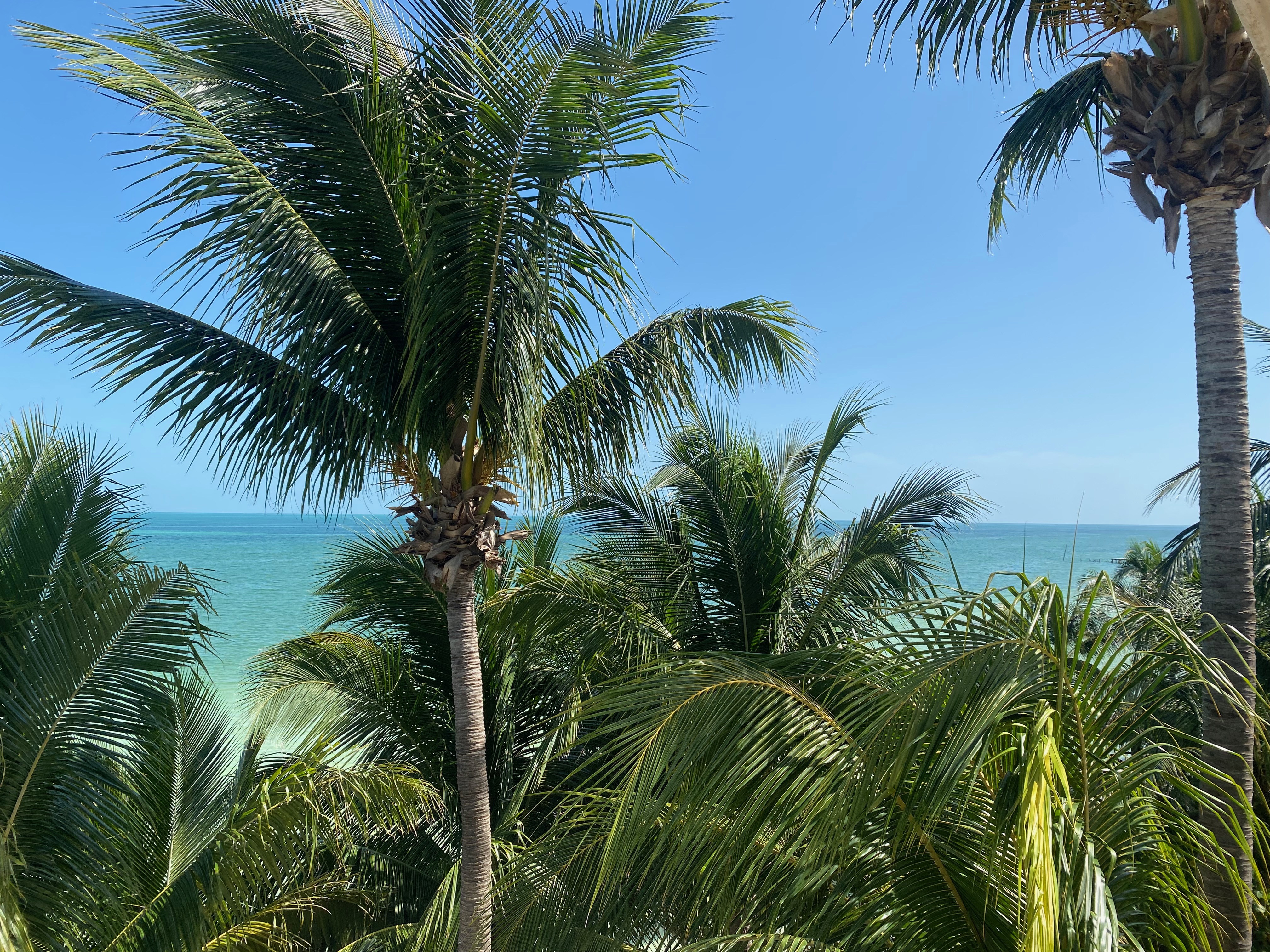
    Been back from a great ten day away from the everyday for a couple of days now. We returned to Holbox, Mexico for a second go-round. The ten day mark seems to be a good enough time to release the stress and pressures of everyday life and not feel like you still need more time. At least that's how it worked for me. Holbox is a barrier island on the Yucatán peninsula about 2 hours away from Cancún. No resorts, but small hotels, good food and lots of water to cool off in. Ten days of doing next to nothing but napping, reading, haivng a drink, swimming and doing more nothing is a great refresher. 
    Since I've noticed that I don't really do much in the way of art while away on vacation, I limited the amount of art materials to some colored pencils, graphite pencils and a sketchbook. No need to add unnecessary weight to my luggage with stuff I won't use. I let a couple of days go by before I felt like doing anything artistic, but once I started, it continued for a few days. My routine was to do some drawing before or after breakfast. That seemed to be the best time for me to get something done since the rest of the time I was in the water, napping, eating or reading. 
    I've been working on some new ideas for paintings for a few months now and that proved to be great fodder for continued low risk exploration in terms of materials and time. I took these mornings to think more deeply about what I wanted to do and how I might want to pursue this work. Just having the time to think without daily distractions was almost enough for me. The cell phone service was minimal on Holbox, so that automatically took away wasted time. I also made it a point to not be online as much as possible, which turned out pretty well. Anyway, the ability to just think and let my thoughts wander was a blessing. I've returned with a much more clear idea of what I'm attempting to bring into being now. There's considerable more work to do before I'll feel comfortable with what's to come, but there's so much room to just play with the ideas now having had this free time away from the regular routines. 
    We returned Thursday evening and yesterday, I spent some time in the afternoon at the studio working on a couple of 50" x 38" works on paper; one vertical, one horizontal. I'm trying to get a feel for how each of these configurations might work once I get to larger canvases and panels. There are going to have to be a bunch of adjustments because of the differences in supports and materials; colored pencil to paint, paper to canvas and wood. 

TM


Saturday, July 08, 2023

Piles


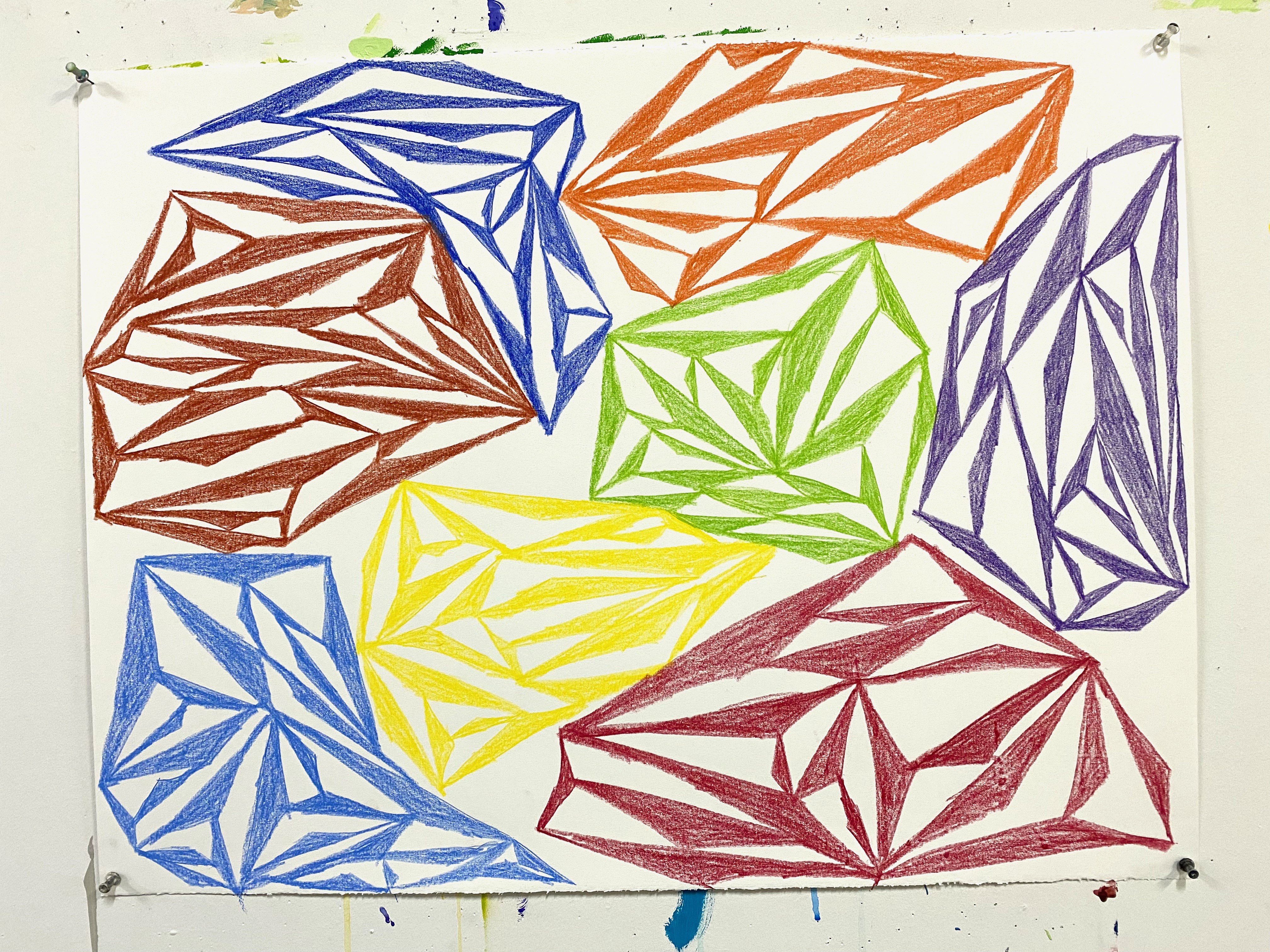
Pile I, 2023, colored pencil on paper, 22" x 30"

Pile II, 2023, colored pencil on paper, 22" x 30"


    Summer's here and Philly's been a humid swamp this week. Thankfully, I have A/C in the studio and don't have to sweat it out. I've paid my dues over the years and am going to enjoy having air for as long as I can. 
    There are a bunch of works in progress in the studio, as always. In between working on some smaller paintings, I also made these two drawings that are part of a new series I'm calling 'Pile'. This idea literally just came to me one day this week as I was working on a painting that has an element of these interlocking triangles within a square of translucent red, seemingly hovering above and partially obscuring a layer of glyphs. My thought was, what would happen if I made a drawing of a bunch of these that filled a page? My only "rule" for these was that I wasn't going to start at any of the edges. Instead, I started with a singular form, within the page, just off center and built the rest of the composition around it. I wanted each form to be a different color as well. 
    So far, so good. The drawings are a nice change from the paintings in that they are pretty void of any considerations other than what color the next form will be and where to start drawing it. The act of drawing these is pretty relaxing, but also interesting in how the piece begins to take shape within the picture plane. That's the other "rule"; that the forms are to inhabit the boundaries of the paper and not seem to extend beyond it. 
    Within each of these drawings, there is an uncomfortable tension between the forms  because they feel like they don't appear to inhabit these spaces with any comfort; they seem to teeter on the edge of falling over. They also don't fit together comfortably. These would make near impossible puzzles. I'd like to make a bunch more piles and have some ideas for future drawings and maybe paintings.The work is changing in another big way and I hope that I can continue to explore this avenue into painting.

TM

Tuesday, June 27, 2023

Need any help?

     This afternoon, I was walking back to the studio from grabbing a couple of snacks. The side of the street I was on has a huge lot of newly built homes set way back from the street. Closer to the street, the lot is mostly rubble and could be another section of the development waiting to happen. Towards the northern end of the lot, there was a guy dumpster diving, pulling stuff out of the construction dumpster and loading up his pick-up truck. He saw me as I was about to pass and, out of the blue, said that he’d just pulled a chunk of an I-beam out from the bottom of the container. I looked over and could see it resting on the far top corner of the dumpster. He was carrying a long pipe in one hand and something else in the other as he worked his way through the fence opening.

    I asked if he needed help and he said, “Nah, I’m alright, did three tours in Iraq”.  I started walking away and said back to him, “That’s great, but it doesn’t mean you won’t need help” and thanked him for his service. My ‘help’ comment was meant to hopefully spark the thought in his mind that accepting help was ok. This was a little presumptuous on my part, I'm aware of that, but his retort about his tours of duty in Iraq brought to mind all of the times I’ve heard men say something similar before going on to  struggle with whatever task was at hand. There are so many reasons why people might reject help, and to each their own. I was just struck by this man's Iraq comment because I've heard that sentiment many times over the years. 

    His comment seemed to be another perfect example of how men appear to be hard-wired to not accept help. A lot of this may be centered in pride and ego, wanting to project strength and individualism. Now, he may or may not have had a problem getting that piece of I-beam to his truck, but his comment about Iraq appeared to me to be a kind of defense mechanism. I’ve heard guys say things like this all of my life. Even going back to childhood, there was always a man around, perhaps struggling to carry something or do some difficult task who turns down help by saying something about some past or present personal achievement of strength or endurance, usually followed by, “If I could handle that, I can do this (alone), too”. My dad was the same way, even as he was breathless and struggling to finish up whatever he was working on. And that’s great! If you can still call on your reserves of individual strength, that’s fine. Although, to me, this mindset  seems like a self-imposed barrier to appearing to be vulnerable and needing help which translates to “weak” for so many men. 

I’m no stranger to this way of thinking. As an only child, I always felt that I had to do for myself before getting anyone else involved. Not in the sense of being afraid of needing help, but because of my upbringing with alcoholic parents. I often felt the need to take care of a lot of things alone, not having the security of knowing that there was someone there to help me in whatever way(s) I needed. This has affected how I process situations where I might need assistance as an adult. Many times, I don’t even know the right questions to ask and have to sit with that discomfort and figure out exactly what it is that I’m after by asking for help. I’m working on it, as with a lot of things. As for the guy and his piece of I-beam, I hope he managed to get it to his truck or was ok with leaving it. 

TM

Sunday, June 25, 2023

All day, all PAFA


    Earlier this year, I was invited to be a visiting artist at PAFA, thanks to the Visiting Artist Program and committee. Last Wednesday (6.21.23), I found myself with a full crit schedule in the afternoon and hour long talk that started at 5pm. I had a great time meeting and talking with the students in the Low Residency MFA program there, where students work at the school in the summer and work virtually for the rest of the year. In my email communications with Jazlyne Sabree, who was heading the VAP committee, a couple of days before my visit, the list of students who signed up for critiques with me started with about four. By the time I arrived at the school, the last slot had filled, which meant that I did back to back 30 minute crits all afternoon, from 12pm-4:30pm with a half-hour break before my talk at 5.

   The packed schedule energized me more than I realized. I really enjoyed speaking with the students and engaging with them about their work. There were a wide range of interests, all 2-D based, but very different approaches to materials and subject matter. Most of the students were in their 30s and above and most had been making art for a number of years, already. One student came to art from a background in law and an additional non-art related career. They all were passionate about what they were doing and all trying to figure out how to keep moving forward with their creative interests. My approach to the crits was to meet them where they are and figure out how I might be able to help them along their journey. They all were really motivated and thirty minutes wasn't quite enough time to dive deep into their practices, but that constraint forced me to be as efficient as possible with my comments. Most of those conversations could have easily gone on for an hour or more. 

    I'm honored that so many students signed up to have crits with me and I hope they all got something valuable out of our time together. I enjoy talking with students about their work because I feel like there's always something that I can pass on to them, regardless of the type of work that they are pursuing. I have over 40 years of experience in making art of some kind and I feel that it's necessary to pass on some of that knowledge so that someone can possibly benefit from it. I tend to shy away from traditional classroom teaching, preferring other ways of engaging with younger artists, like these visiting artist critiques and talks. I think that it's vital for artists to be open and willing to share their knowledge with others. 

    The talk almost didn't happen, haha! I had my presentation on my laptop and on a thumb drive, both of which I took with me. The only issue was that I 'thought' that I'd exported the images as Powerpoint files (from the Keynote files on my Mac laptop), but hadn't and the school's tech is Microsoft based. Anyway, near panic ensues as the tech person went to the library to see if they had a Mac that they could use. However, William Lawler, one of the students that was helping me out suggested that I try to export the file again and this time, it worked, and just in time. 

    This was the first in person artist talk that I'd given since before the pandemic in 2020. A couple of weeks prior, i'd been part of a panel discussion, but that was different. Here, it was just me presenting my work and ideas to an audience. In short, I'm told that the talk was good. From my end, there were a few points that I meant to make, but somehow managed to gloss over because of a small amount of nervousness in worrying about time (roughly 45 minutes for the talk and the rest given over to audience questions) and making sure I was clear in my delivery. I feel like there's room for improvement, but enjoyed the opportunity and am open to doing more in the near future. My talk will probably available on PAFA's website soon. I may hold off on watching it, but will get to it eventually. 

TM

Sunday, May 28, 2023

Residue and all


Three views of a work in progress

    A big part of the philosophy behind my work is making something out of the residue of human existence and its effect on the built environment. There's something about the randomness of leftover marks and other interventions on buildings, in streets and other places that contribute to the story of a place. This appreciation for the residual material of life extends to my studio work, where I'm usually finding ways to reuse materials all of the time. This is often in the form of reusing panels that I use for paintings where I'll sand down old images and/or cover up those images to make new work. I like to save and reuse dried acrylic paint skins that accumulate on the plastic-sheet covers of my foam board and cardboard palettes. The same goes for excess paint; I usually mix it all together in a container, making a chromatic gray that's always unique depending on the mix of colors.
    I've been thinking about how I could use my paint cloths as art after they've become too hard and non-absorbent to properly clean my tools. The idea was simple: flatten the cloths as much as possible, use matte or gloss medium to adhere them to one another, and add drawings and paint as necessary. Sometime last week, I dove in and started figuring this out. I grabbed a bunch of the cloths, arranged and attached them in an off-kilter semi rectangle. I let the acrylic medium cure overnight, leaving the form a little stiffer and a lot easier to draw on with acrylic markers. I made  a series of glyph grids on the surface of various sizes and combinations. Some of the marks I made disappeared a bit due to the paint being absorbed by the places on the surface where the medium didn't take. For a first attempt, I like it, so far. 
    One thing that's I've been thinking about is how much mark making to impose on the piece and how much of the original paint stains should I let remain untouched or uncovered. I'd like to keep quite a bit of the original marks, enhancing them here and there. There's a lot of room for experimentation and since this is the first piece like this, it's tempting to throw a lot at it. However, that's not what I want to do. I don't want to overwhelm the work and will probably make another one out of some of the remaining cloths in order to spread out some of my ideas and not have only one bear the weight and responsibility for all of my ideas. Excited about where this could go. 
    Also, I have the work of painter Jason Rolf to thank for planting the seeds of this idea years ago after I followed him on Instagram.  I'm just now getting around to figuring out how this might become a part of my art making, but all things in their own time. 

TM
    

New Artist discovery: T.J. Ly-Donovan

    As most who might be reading this now, Instagram is a treasure trove of artists. I'm finding out about new-to-me artists all of the time and thought it might be good to share them here, as well. First up is someone I just found out about today named T.J. Ly-Donovan. I couldn't find much about them online, so here is their IG account link: T.J. Ly-Donovan on Instagram

T.J. Ty-Donovan's work is very material based and lives in that space between painting and sculpture. Craft foam, board, oil paint and various materials make up their unique wall-based pieces. Ly-Donovan doesn't seem to have a website, but if I come across any more information, I'll post it here. 

TM

Thursday, April 27, 2023

Artist & Place podcast: Time and the Cracks Between Things


 About a month ago, I had the pleasure of sitting down with artist Kim Carlino in my studio for a lively conversation about art, life, the role that place and landscape plays in the creative journey, and more for her podcast, Artist & Place. One thing that I've learned from listening to this episode is that I can talk a LOT. I don't always like hearing myself when playing back interviews, but I'm getting better about it. I listened to this one all the way through on the first day that it came out, now that's progress!

You can listen to the podcast on most platforms, including Spotify, Apple and others. Here's the link and thanks for listening: Tim McFarlane: Time and the Cracks Between Things

Friday, March 24, 2023

3.24.23.1


     Got to the studio around 10am this morning which, for me, is great. On average, I'm here much closer to 11 and after, so this is a good development. I've been trying to arrive here earlier in the mornings, but I tend to stay up too late and haven't been good about breaking that habit. Anyway, I'm here now and that's all that really matters. 

    I was on the bus and remembered that I wanted to stop and buy a couple of things to use for drawings, but realized it too late when I was on the bus. I was going to stop by Artist & Craftsman Supply at 3rd and Market and since they were close to opening, I may have been able to get in early. I might make a trip there later, anyway. I really don't *need* to go today, it can probably wait until tomorrow. The thing is, I have this idea locked in my head and have that urge to go and buy the things I want now, as opposed to waiting. Let's see how the rest of the morning goes.

TM

Thursday, February 23, 2023

The art life is not a luxury

 “Art is not a luxury”: a phrase that I once saw on a bumper sticker a long time ago and that I used as part of my “signature” on one of my old email accounts. I’ve been thinking a little lately about the word “luxury” as it’s applied to the things that artists make. In the greater public mind, art is considered a luxury commodity because of how it is portrayed in the media through the lens of commerce and capitalism. Big auction numbers of works by household names like Picasso, Rembrandt, Michelangelo, etc…are often the only connection that many people have to art. When it comes to living artists, only the most ostentatious displays or those generating controversy and public comment made are given any kind of notice, the latest being Hank Willis Thomas’ public work of an abstracted embrace of the late Martin Luther King, Jr., and his wife, Coretta Scott King. The work has garnered a lot of attention for how it’s perceived at certain angles; that it resembles an act and anatomical feature of a sexual nature. There are many shades of how art is perceived by the general public. My focus here is mainly on the idea that living a life where creativity is at the center of one's life and livelihood is somehow a “luxury”. 


The context in which most artists might hear that they “have the luxury of being an artist” and everything that goes along with that, is usually from people whose daily work feels like anything but creative, and some artists. Most artists have had to work other jobs in order to pay bills, studio rent, have funds for materials and have the basic necessities of life. Many of us, myself included, have considered the life of being a full-time artist as being a luxury. The “luxury” of being able to do something that is self-determined. Contrast that to how most people spend their lives essentially working for someone else or a larger entity (corporation) where most of what you do is determined by someone else. Again, this is a broad stroke, as there is a huge spectrum of experiences and comfort when it comes to working for someone else. However, often in those situations, people look at the perceived life of a full time creative as being one free of the drudgery and repetition of say, certain types of office work or other regimented occupations. 


While it is usually true that being an artist can be free of certain regimented time and restrictions inherent in everyday work life, it too, has it’s routines and necessities that require us to pay heed to things that we often find laborious and tedious. The need to write artist statements, statements for grant applications, the ongoing search for opportunities to show one’s work, researching materials, keeping good records of sales and expenses, budgeting, finding supplemental income when art sales are slow, actually making the work and the list goes on. The day-to-day life of artists is very much like other occupations, it’s just perceived through a lens of being different, somehow, which it is, but not for the way that so many like to think it is. Creatively centered lives are seen as luxuries in the U.S. because the perception is that creativity and art are things outside of ordinary life, and it has become like that over time as art has become a specialization and not as much a part of everyday life as it once was. Eventually, there came to be certain people in a village or town who were specialists; the shoe maker, the weaver, the furniture maker. Once machinery and specialized businesses took over many of the tasks of making most household items, including parts for houses themselves, art and craft became further specialized in life and education. Art is now mostly considered outside of the spectrum of everyday necessities because there is no longer a need for everyone to make their own furniture, clothing and countless other things like it used to be done. Art now is largely considered outside the scope of everyday life and experience, even though that’s not true at all. 


Art is taught as its own specialty and artists are now deemed specialists when it comes to creativity, in general. Need a poster for the school play? Get Mr. Smith’s art class to make one. Need some graphics for a new merchandising campaign? Let’s get the design department on it. Want a painting of your grandmother in her garden? Let’s talk to Susan down the street, she’s an artist and on and on. This isn’t the worst thing, however, my point is that we as artists should abolish the idea that our time spent making whatever we make is somehow a luxury. I’ve had this same mentality going back years. Almost any time I’ve talked to someone about what I do, I’ve always said that whatever time I’ve had in the studio is a luxury. It really isn’t because what I and countless others do is absolutely necessary, whether the larger society deems it so or not. What I’m arguing for is for artists to abandon the dominant way of thinking about our work time as something that’s on the fringes of existence. No, we aren’t “lucky to have the luxury of making art”, we’re people who are doing the job of creating culture. There’s nothing luxurious about it, It takes a ton of hard work, patience, nerve, grit and more hard work to do what we do and luxury has nothing to do with it. 

Monday, December 19, 2022

Looking, thinking, digging deep...

Contemplating a new painting
      I like to say that at a certain point in the painting process, watching me work is like watching paint dry. At first, there's usually a lot quickish choices being made about color, form and placement. Then, once I've gotten over the usually annoying mid point of making the painting, there's a slowing of mark making and much more contemplation of what's in front of me. I have a habit of looking at my paintings from all sorts of odd angles at times. One of the most unconscious positions is turning my head sideways instead of the painting. I was taught long ago that you should rotate your paintings to see how they are working from different directions. The classic move is to turn it upside down. This is used as one way to determine how the painting is holding together compositionally. The point is that there is a lot of thinking going on when we're sitting or standing in front of a work. Even when I'm not in front of it, like at home or some place other than the studio, the work is on my mind. I'm mulling over possibilities of changes or placement of forms as I'm walking down the street. I'm trying out all sorts of compositional possibilities when I'm in the shower. I'm considering which new materials I could use as I'm washing dishes. The work is never ending, but I also love it this way. 
   Last week,  I found a couple of chairs in the hallway of the floor I'm on in the Crane Arts Building that someone didn't want any more. I took them in because they're softer and generally more comfortable than the hard molded plastic chairs I already have. They both have old thin leather covering the back and seat. The frames are made out of silver metal of some sort. I brought them into the studio, wiped them down and am enjoying having them. I still need to get a couch in there. Studio naps are essential not only to my well-being, but the well-being of the work. 
    Trying to push through sleepiness in the middle of the day or late afternoon is tough without a proper place to take a nap. I feel like a good hour to hour-and-a-half is a good period of time for a nap. They are so necessary for helping to keep my mind clear during the day. Taking time to nap is so beneficial for thinking. Art is really taxing mentally and physically sometimes. It's best to try and keep your mind sharp so that you don't go about making bad choices in the work. Well, bad choices happen regardless of napping or not, but the likelihood of them increasing is greater without resting a little during the day. 
    I watched a "behind the scenes" video with Tom Cruise that's the beginning of the hype machine for the next installment of the "Mission Impossible" franchise. This one was interesting to see because it shows how much of a committed actor TC is. He is known for doing a lot of his own stunts and this video showed just how deep that commitment is. One of the big stunts is him riding a motocross bike off of a huge ramp, off the side of a cliff and then parachuting down into a ravine that's closed in on three sides with rock face. He trained on riding the motocross bike, practicing the jump, learning to parachute from a helicopter and even more than that. He did all of that and did those actions over and over and over again to get everything as right as possible to make an action sequence as believable as possible. Seeing that kind of dedication to honing just one part of his craft made me think about how much we as artists need to make sure that we're doing all that we can to keep ourselves educated, doing research and pouring as much as we can into the work that we do. Being persistent, consistent and risk-taking with your work habits in the studio and digging deep within to make the best work possible will pay off. Show up for yourself!

TM


Tuesday, December 13, 2022

Paintings being free

 (Detail :: work in progress)


    Online recently, I made a post that mentioned a shift that I feel is happening in the work. Yesterday, that feeling became even more clear to me. What's happening is that I need to take a break from making the dense, glyph-filled work that I've been doing for the past few years. The glyphs will still be in the work, but I'm kind of done with the denseness of mark making that's been going on for a while. Two recent paintings that I've worked on sealed that feeling for me. I was having a real struggle to complete them and couldn't figure out why until just this past weekend; I'm just tired of what I've been doing. These paintings feel heavy in a way that bugs me. Everything about the work feels heavy; the surfaces, the compositions even the colors, many of which are repeated in similar ways throughout recent paintings. The paintings are breathing laboriously at this point, wheezing even. It's funny how palpable the feeling of discomfort around this work has been for me lately. It literally weighs on me, almost oppressive to a certain degree. I feel the need to think about why this is a little deeper.
    Even as that revelation has become more clear to me, I've already begun making some paintings that are moving down a separate, but parallel track. I've been making some works on paper centered on these forms that are basically interconnected triangles. It's been something that I've played with off and on over time, but now I'm feeling more comfortable with how I might be able to put them to use. I'm hoping to create some different color and spatial relationships within the work where they behave somewhat similarly to the glyph paintings, but are completely different in execution and how they behave on the canvas or panel supports. 
    I can trace these new works back to some things I've done since 2013, but I haven't been able to figure out what they mean for me, yet. That's probably a good thing because they will define themselves over time. Compared to the various connected influences of the glyph paintings, these new works are very much their own thing. They exist outside of everything that I've been focusing on over the past seven or eight years. They are as alien to me as anything that we may call biological that might exist somewhere else out in space. They have a history for me, but I haven't been able to identify them, yet. They are resisting categorization, which is somewhat frustrating, but also very freeing. They aren't tethered to any kind of ready-made philosophies or uses. They insist on being what they are without outside intrusions of meanings. 

I'm perfectly fine with that. 

TM

In silence


     I like to take a few moments to be silent and express gratitude when  I come into the studio for the day. It really helps to ground me and remind me of all the good things that have come into my life through my actions and otherwise. I had hoped for years to have a larger studio again after having to move from the space at 16 N. 3rd Street back in 2015. I don't like to take things for granted because everything can crumble, turn to dust and disappear in an instant. I worked hard to get here, with help along the way, and I'll never forget that. 
    Since moving here, I've been able to look at my work in a completely different way than I have for the past seven years or so. Just being able to have the room to step back from something and see it in relation to something else that I'm working on a few feet away is truly powerful. I get to walk a few yards away from a painting and can really take my time with letting it live and come into being on it's own terms and not with the crush of all of my other work right on top of it. It's an amazing feeling. 

 TM  

Bringing others in


    Coming off of my birthday weekend, I gave a workshop for teaching artists of Mural Arts Philadelphia this morning. Things seemed to go well since this was the first time I'd led an activity in a workshop like this for peers. The actual first workshop ever was last spring with some of Brad Carney's Mural Arts Education students at George Washington High School in northeast Philly. This workshop was focused on showing the participants how they can use translucent materials like tracing paper or drafting paper to create interesting layering effects in their work. 
    It's very educational when you have to interpret what you do in your studio practice for other people in a situation like this that demands clarity of communication and thought. You have to really look deeply at what you do in the studio and find ways of connecting people with what's mostly in your head otherwise. What seems simple to you can be a complete mystery to others, even artists. We all have our own experiences with making art that are often as completely singular as we are as individuals. That makes sense for obvious reasons, but we don't often think about that because of the myopic lens through which most of us look at the world.
    That's not an indictment, I'm just stating what I see as a part of the human experience. All of us are made up of what ever experiences we have and tend to look at the world in a particular way as a result. Problems occur when we can't make room to appreciate how others might experience things in their way. Being able to empathize is a huge thing and a lot of the bad experiences that we have with people who can't or won't accommodate other world views shows up in horrific ways. Learning to effectively share and communicate your ideas and processes with others is a huge thing and not something to take lightly. It's a key way to better understand what you're doing in your work, bring you closer to other to others and help them understand who you are as a person and artist. 

TM
 

Monday, December 05, 2022

How long...?

Detail of No Way Out (2022)

[The following is copied verbatim from a recent social media post I made last week. I felt like it needed to be enshrined here, too]


Studio 12.01.22 :: I felt a perceptive shift within me regarding aspects of my work now and possibilities moving forward. Yesterday evening felt like a moment where the dust of years of different paths and influences collided and started forming a couple of new ways forward that I feel absolutely compelled to follow. An “oh shit, yes!!” moment that packs a bigger punch than others in the past.

The question of inspiration comes up once in a while and my answer is always some version of “life and doing the work” that I elaborate on. First, no idea comes from a single influence or source; there’s always a constellation of experiences-conversations, random thoughts, dreams, research, whispers, daydreaming, reading, music, doodling, walking down a different street, noticing that tiny crack in your glass-that can lead to where you are now. Everything that you’ve lived through is right in that moment of discovery. Second, I don’t believe in waiting for “inspiration”. That comes from doing the work, whatever that is for you. You don’t get anywhere sitting and making yourself frustrated that inspiration hasn’t swept you off you feet. It won’t, trust me, I know. Doing and actively participating is how discovery happens. Begin where you are with what you have and see where that takes you. Rinse and repeat as needed 

“How long did it take to to do that?” My whole life to this point, literally.
 

Monday, November 28, 2022

CONTENTS/INTRODUCTION/Vegetables

CONTENTS

INTRODUCTION

Vegetables


    These images came together in a couple of bursts of ideas between Saturday and this morning. Saturday, I was here in the studio and had the urge to return to drawing over book pages, specifically this old House and Gardens New Complete Book of Gardens that was published in 1955. It's a used book that I bought from Mostly Books on Bainbridge Street for $5 years ago. I've been using images and pages from the book to make collages and other things. One project that I like a lot from around 2015 or so is called "Notes". "Notes" consists of several images from this book that I tore and then drew glyphs on. I had them up on my old studio wall for almost seven years when I moved out this past summer. 

    First, I drew on and collaged the pages and photographed them on the floor of the studio, with the book leaned up against the wall and the "Vegetable" page taped to the wall. I didn't want to use push pins in it. That was Saturday. This morning, I woke up too early, as usual and got the idea to incorporate some digital aspects into the photos and that's what you see above. I imported the photos into the PicsArt app to make the additions. 

    Anyway,I've been into drawing over book pages for a while now. In practice, it's been more sporadic than I'd like, but I feel like I'll be doing more with this idea now. I like drawing on these book pages because the printed images give me something to react against with my own mark making. It's another way of imposing one's mark on something that already exists, i.e., graffiti. There's also something about marking up older books like this that are very orderly and represent life from another era. The gardens and layouts presented in this book represent a certain type of suburban ideal that has levels of social complications, to say the least. 
     
    The immaculately manicured gardens and plans seen in this book brings to mind ideas about class and race from the jump. Only a certain class of people could afford many of the extravagant gardens pictured within and you definitely had to be of a certain racial background to be able to have anything like this in the '50s almost anywhere in the U.S. If you were Black and could afford it, most often, you would be pushed to consider something much less nice and in a Black enclave because the subtext is that suburbia was only for whites. I know there might have been exceptions to this, but those exceptions were probably few and far between. When I think of the suburbs, I automatically think "white", even when I know that's not the case in today's world. With the scars of segregation and Jim Crow laws from those times still here, being Black it's hard to look at anything from the '50s and feel good about it. Combine that with how much things haven't changed in our society regarding race and acceptance (witness these past couple of decades and especially the past eight years). 

    With that said, taking my marks and superimposing them over the book images feels good in a lot of ways. I even took a few pages from it to make a loose series of images I dubbed, The Great (Suburban) Outdoors. Being a fan of nature with hiking being one of my favorite activities, the sterility of a lot of suburbs with their subjugation of nature into "manageable" plots of land feels like an affront to nature (and it is) "But people have to live somewhere and not have plants, grass and trees grow wild..." *insert eye roll*

    It's complicated. This is only me getting some things off my chest. However, I like how these digital images came out and I already have more edits in mind. I'll probably make more soon. One thing that I have to balance is making sure that I don't get overwhelmed with the sheer enormity of editing options these days. If I didn't restrict my choices for what parts of the app to use and which to leave alone (for now) is unbelievable. For these, I had a couple of problems to solve. One was making sure that the image fit into the square format for Instagram because one of the original photos was horizontal. The other was using colors with each image that complimented the image in some way and didn't overwhelm the photo. i think this worked out pretty well, although I'm already thinking about how to possibly make this idea better next time. 

TM

Saturday, November 26, 2022

What I've learned...so far...


In my latest studio newsletter, there's a section called "Exit" where I posted an Esquire Magazine-like series of statements about my experiences of making site-specific temporary installations, like Tumbler, that's now on view in the Speer Gallery at the Shipley School. The magazine section is called, "What I've Learned..." from which I borrowed the format for my version of it. My "What I've Learned..." are reflections on my ongoing project of making temporary installations made up of drawings on large sheets of paper, clear acetate, silver mylar, frosted mylar and, in the past, tracing paper. Tumbler is the third, and largest, iteration of this idea. 

The making of Tumbler was different from the previous two because there were people passing through and present in the space where I was working between classes. I had to be more careful than usual about keeping my materials out of the way of students and staff passing by, as well as being aware of being watched, however briefly, while making the piece. I wasn't particularly worried about that aspect, but it did make me a little anxious at times, as working in a public or semi-public space will do. In the end, I channeled that nervous energy into a laser like focus on the work. I learned some new things and am grateful to have had this experience that I can now take and use for the next one. 

Without any further delay, here's what I've learned about making site-specific works in public/semi-public spaces, so far...

- I always wind up buying more nails than I really need

- Making unplanned work in public forces action

- Fear creates energy to move ahead with the work

- Having people witness your creative process can be affirming

- Having people witness your creative process feels like electrified nakedness

- Using the drawings in different places and ways always seems to open up new possibilities

- I love manipulating (tearing, folding, creasing...) the drawings from one installation to the next and seeing how they change

- When that weird middle section of the install happens and I want to rush to get past it, I let myself feel the angst, and then take extra long, deep breaths and walk away if need be. Same as when I'm in the studio. 

- My palms always get sweaty when it comes to heights, no matter how safe I am

- When people ask questions about what I'm making, it forces me to get better at making good, short answers

- My stomach is in knots the whole time

- Transforming a space through artistic intervention is a great uplifting experience

TM

Thursday, November 24, 2022

Easy isn't bad

New painting (detail)

"It’s easy to romanticize struggling, to think that something must be difficult to be of quality" 

"Yes, this is so important! I think a lot of visual artists and other creatives fall into this mind-f&%k where they believe EVERYTHING must be a struggle and the harder it is to make, the better it is, when that is absolutely not always the case. I've had to make room to be ok with making something that was "easy, so I really understand what you're saying. Just because it's not causing you to have a mental breakdown doesn't mean that you shouldn't do it or that it's not good. If it brings you some joy or spark of some kind, then it's good."

• • • • • •

     The above quote and response comes from my reply to a friend's IG post about making things that are "easy" and still of quality. I've had my battles with the way of thinking that can infect creative people across disciplines. The myth that "all great art is the result of struggle" is just that, a myth. A way of thinking that follows from the idea that life is hard and when you struggle to gain status or other social/financial reward, then that reward carries even more merit somehow. With artists, it's perceived that struggles with mental illness or other neural divergent behavior is somehow responsible for their art rather than that person being able to make their in spite of their mental illnesses, not because of them. 

    I've not had any issues with mental illness in my life, thankfully, and that has never been a barrier to making good art. I'm not in the position of determining if any of my work is "great" or not, but I can say that not having a mental illness or addiction problem hasn't stopped me from making what I consider some very strong, worthwhile art work. Now, I do struggle with aspects of my work all of the time, but that doesn't equate to the work being better than something that was "easy". All I'm getting at is that artists need to reject the notion that they have to have a bad life or bad experiences to produce good work. It's complete nonsense. 

    I've struggled with making and/or appreciating work that I considered "easy", where the solution came so easily that I questioned the work's worth. Over time, I've gotten better with this and now find myself embracing a much wider range of thought surrounding what makes my work good or not in my eyes. The easy stuff should be embraced and enjoyed as much as the more difficult work. It's ok to make "easy" work and to enjoy it. There's nothing wrong with liking your easy work. If it brings you joy, why not? Something that you work on for days or months doesn't necessarily mean that it's any better than something that you made in a half-hour. Your worth as an artist isn't tied to how long or how hard something was to bring into existence, your worth as an artist is what you make of it. Nothing else. 

ArtSmack


    It was a podcast kind of day in the studio. One of what could be a new favorite art pod is ArtSmack, hosted by Jerry Gagosian and Matt C. In a nutshell, Jerry Gagosian, aka Hilde Lynn Helphenstein, has made a name for herself with satirizing and poking fun at gallerists, institutions, art fairs and more through her meme-filled Instagram page. The ArtSmack podcast is no less entertaining and enlightening. Give it a shot!

Tuesday, November 22, 2022

(Not Just) Another Day


Above: palette (might make for a not-too-bad painting)

    Recently, I ran into a young artist that I know in the stairwell of our studio building. I asked him how things were going in the studio where he works as an assistant and he replied "not bad". Then I asked, "How are you?" and he replied, "Well, you know, just another day..." I was on my way out to grab a couple of snacks from the nearby supermarket and once I was outside and on my way up the block, I thought about what he'd said, "...just another day..." In the past, that phrase might not have bothered me that much, but for some reason it hit different this time. My thought was, no, this is not "just another day" and it kind of saddened me a bit because we seem to be conditioned to view each day as just like any other in our routines. 

    Now, the phrase "just another day" is often used as a metaphor for "nothing special is happening, I'm just going about my regular routine", which is often the case. There's a certain amount of surface sameness in a lot of our everyday lives which makes it feel like one day is just bleeding into another without any kind of distinguishing value. On the other hand, "just another day" can also elicit feelings of heaviness and/or sadness, coded language for "this is just another day of drudgery and misery"

    I feel like this is symptomatic of how work culture in the U.S. tends to drain as much joy out of our daily lives as possible. There is so much outward sameness with our routines around jobs, going about our daily tasks and other things that repeat hour after hour, day after day that it's hard not to think of each day as the same as the last. All of us here need to figure out how to bring money into our lives just to be able to live day-to-day. That often leads us to be employed in jobs that we don't like, that I think most of us would quit if it weren't for whatever our needs are. 

    What I believe I heard in the young artist's "Just another day" was this: "It's just another day of giving my energy to someone else's pursuits, dreams and goals". I know that's how I felt during the years where I worked in retail jobs while also making art and having shows. No matter how much I liked where I was working, and I had a couple of favorite workplaces, there was always that feeling of frustration in the back of my mind about giving over so much of my energy to a job that advanced someone else's goals and not my own. In 2020, I got to walk away from my last regular job to pursue my life as a "full time" painter. I put full time in quotes because no matter where I worked in the past, I always prioritized my art life over the steady job. When you're an artist of any discipline, you're never divorced from what you're creating because it's always on your mind. When I was at work, I'd be going over ideas and possibilities in my head about what I wanted to do the next time I was in the studio. 

    Even though those days weren't strictly the same, the overall feeling was that they were because of the baked-in repetition of tasks. Some days, I'd feel more annoyed than others that I had to be at the job when I sorely wanted to be in the studio working out whatever my latest ideas were on the canvas, paper or panel. At times, it was visceral and others, not so much. I remember saying in response to "how are you?" something along the lines of "Same old, same old" or "Another day, another dollar", etc... just to keep from sounding too negagtive. Now that I get to come to the studio and do what I want to for myself, I've come to better understand how different each day really is. It's all perception; if it feels the same as yesterday, then it's the same to you. The reality is that this day and the next and the next, are entirely new. There's so much that's new that it's easy to take for granted if you aren't tuned into it, or even able to be tuned into it because of whatever else is going on in your life. 

    I think my take on each day being new and treating it as such also has to do with getting older and realizing how much less time is ahead of me than when I was younger. These days, I'm trying to make sure that I acknowledge every day as a new, original, never before seen day. Even as many of my days include some tasks that I don't always feel like doing, it's all for the greater good of advancing my creative priorities. I do my best to not take any day for granted because we aren't promised anything. Just waking up to a new day is a blessing that I embrace with all of my might and am thankful for. I now truly understand what my elders were saying when they said something similar when I was little. I really get it. 

Sunday, November 06, 2022

"Evidence" install at The Shipley School


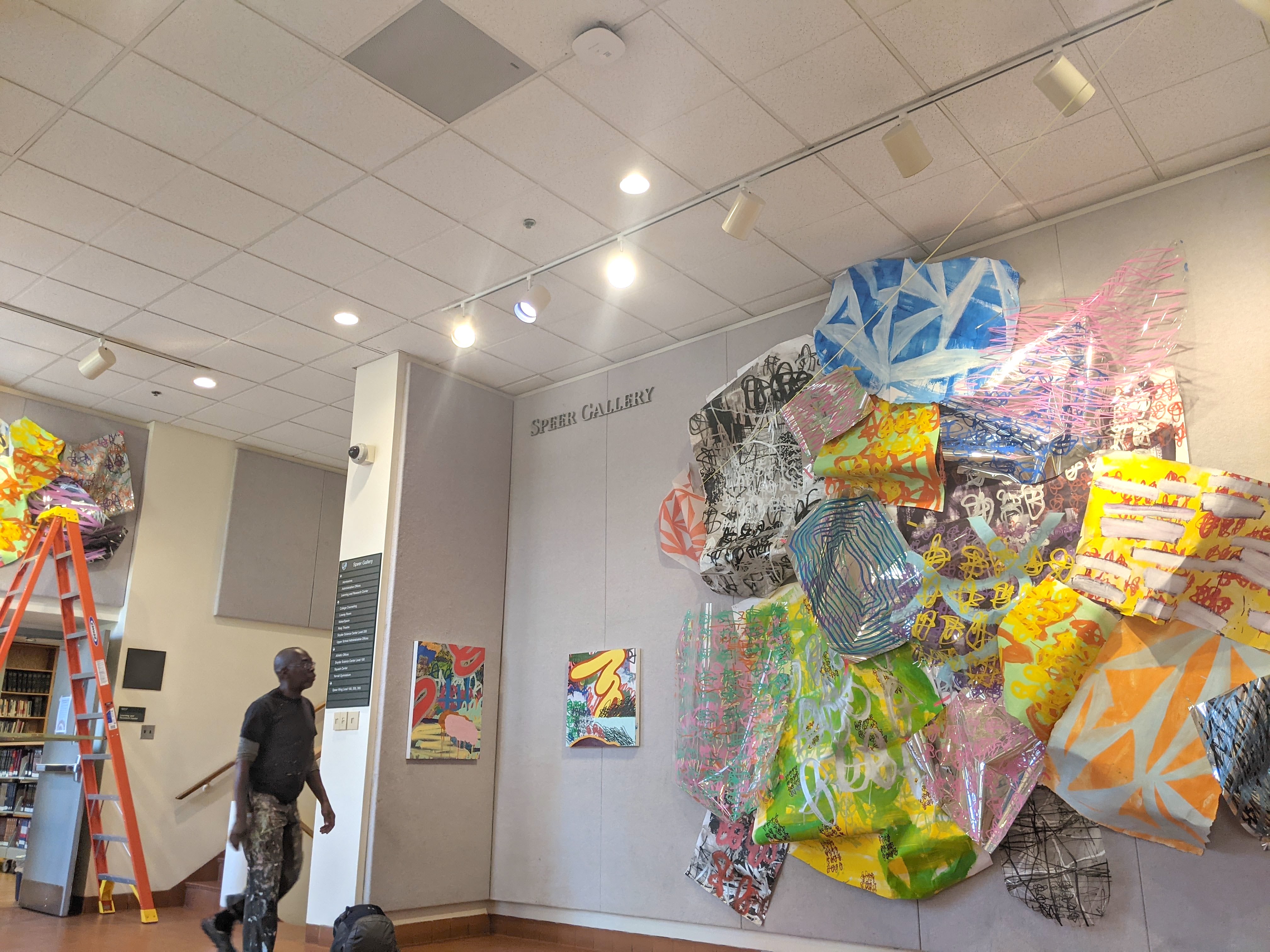
Above: Images of the works in Evidence and Tumbler being installed in the Speer Gallery last week


 It's been a week! I spent last Saturday installing nine paintings for my solo show, Evidence, at The Shipley School located in Bryn Mawr, PA. Months ago, I was contacted by Meredith Turner, Co-Chair of the Art Department/Speer Gallery at Shipley about the possibility of showing work there. We exchanged emails, but it took some time for her to get back to me due to a death in her family. Anyway, when we picked up the conversation again later in the summer, I was definitely ready to see what was on the table. I went for a visit between trips abroad, enjoyed meeting Meredith (meeting her again, I should say because we were students in the Department of Art and Art Education at Temple back in the 90's at the same time). 

    She showed me around and explained that her and another teacher there, Carol Royer, were co-chairs in the Art Department and for the gallery. Carol and I once shared a studio space back in the early 2000s in Old City, at 16-A North 3rd Street. Meredith explained that they had just taken over the running of the gallery and were looking to do some new things with it, liked my work and asked if I'd be willing to have a show there. She also mentioned that she was open to different ideas about how to use the gallery space, so I accepted right away. I had an inkling of what I wanted to do, but not a clear picture at that time. It became more fully formed as time passed after that initial meeting. 

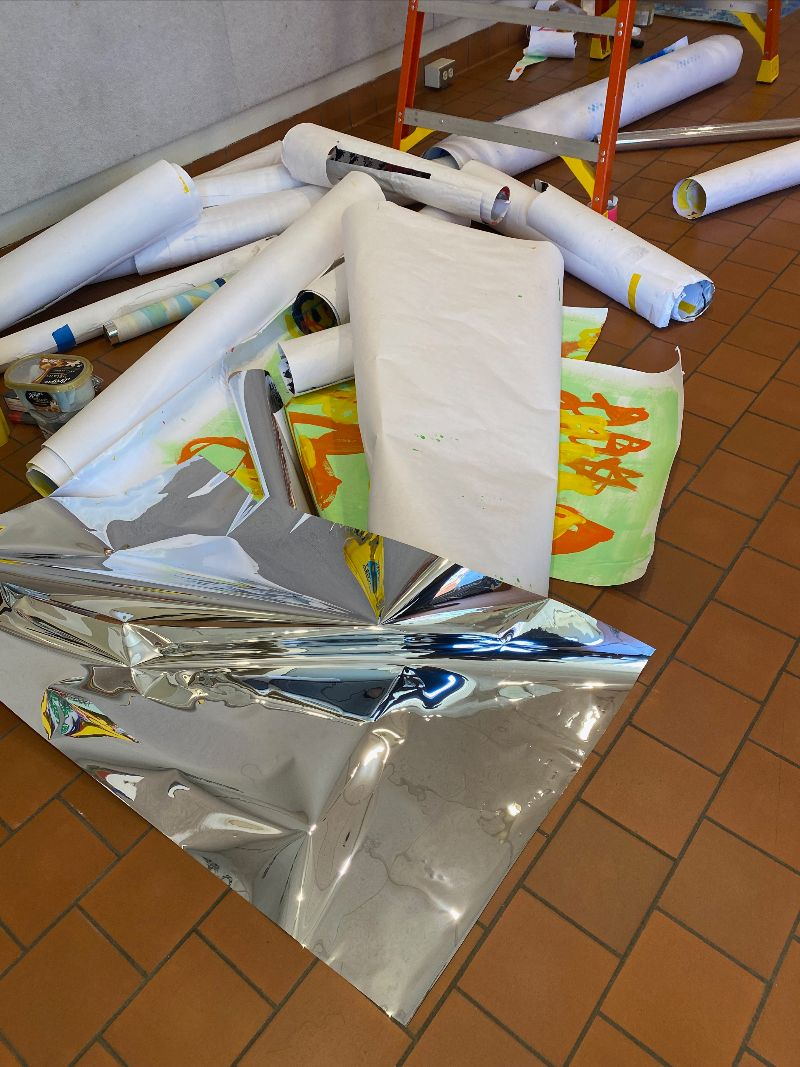
    What I came up with was showing a number of recent paintings from 2020-2022 that hadn't been shown,yet, and making another site-specific wall installation. All of this I did last weekend and on Thursday and Friday of last week. The wall piece, like the past ones, is made up of drawings on paper, frosted mylar, silver mylar and clear acetate. The drawings are creased, folded, returned to their original shapes and then installed on the wall with no prior plan as to what will go where. All of that is figured out as I go along. The main part of this one, Tumbler, wound up being circular in form. I added two other parts on opposite walls and connected all three with colored rope extending from various points on the three walls. The gallery space is very vertical, so I wanted to take advantage of the ceiling height to make something that would cause the students and staff who traverse that area to experience that space in a radically different way than they usually do. 

    Like with other pieces like this, I was surprised that I was able to bring it all together over two days. The small amount of planning that went into this went a long way. As I mentioned above, none of how it turned out was planned; I only knew what materials I wanted to use and I wanted to place the various elements of the work. The reaction to it from staff and students has been very positive and I'm looking forward to talking about it more on the 17th, when I'm scheduled to give an artist talk. The reception is on the 18th. I sent out a studio newsletter announcing the show with details that I haven't posted on social media yet. I'm trying to get more subscribers because I'm attempting to give people more value with the newsletter and not post certain things online, or not posting online until much later. We'll see what happens. I don't  blame people for not wanting to sign up for another newsletter because I know we all have overflowing inboxes, but I'm still going to keep trying to expand this aspect of my marketing. It's been slow going in gaining new subscribers and I think I may have to add more incentives in the future, like giveaways of small drawings or something like that. 

TM